Friday, 26 January 2018

DMIC: Our Initial Discussion With Bobby Hunter

Developing Mathematical Inquiry in a Learning Community
Bobbie Hunter

The staff at Pt. England has begun having PD with Dr. Bobbie Hunter, Massey University.  We are looking into creating a learning community for our children that involves teaching using a mathematical inquiry model.  Here are my notes/thoughts from our first session as a staff. 


What DOES work for diverse children will also work for ALL children. We need to be developing children who are doing the thinking...not just listening.

There is a misconception among many NZ primary teachers that Pasifika children come to school ‘not knowing anything’ when it comes to maths. However, the truth is that they know a lot of applied maths (setting the tables, laying out the mats, cutting sandwiches into fractions, etc).

It is important to provide current cultural context for our students. They may be Samoan but they are living here! What are the things they experience on a daily basis in their immediate environment.

NZ has the widest disparities between the cans and the cannots when it comes to kids and maths.

It is important to remember that Culture and Mathematics are Intertwined

Every culture uses maths in context to items that are specific to them. Students need to be encouraged to share intellectual problems that relate to them. When writing problems always ask, “Will my students be able to relate to this question?”

In order to bring the cultural aspect into a classroom you MUST look at their values.
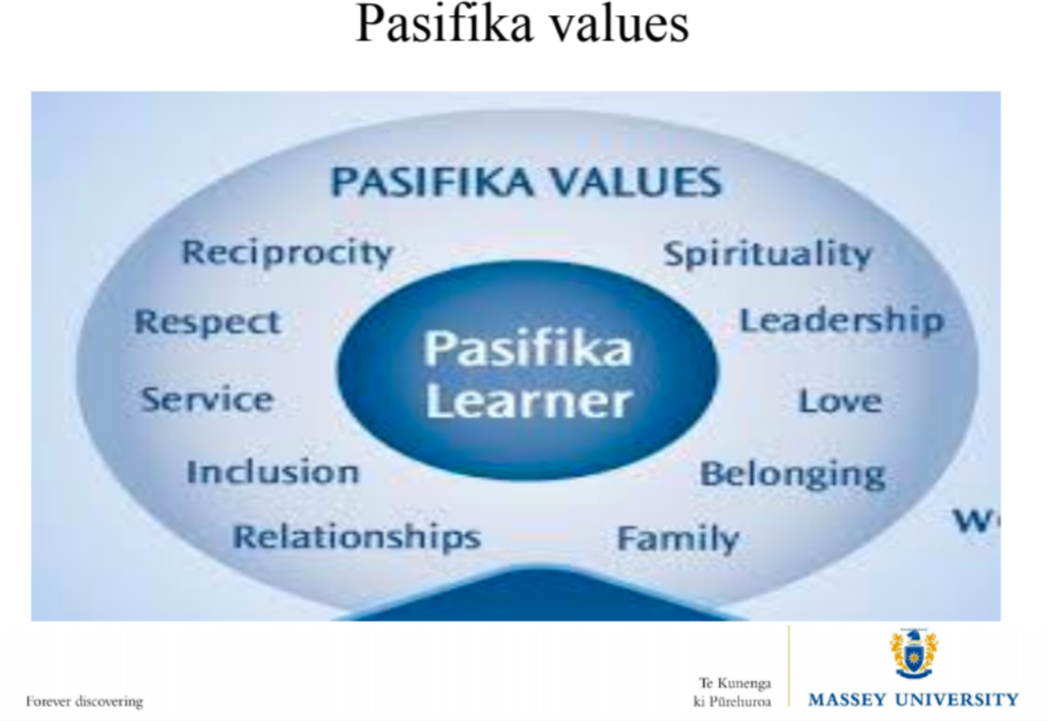

Instead of saying “work as a team” rephrase to “work as a family”
Service concept - idea of individually helping others before helping yourself


DMIC-Developing Mathematical Inquiry Communities
  • Connected, rich mathematical thinking and reasoning
  • Proficient use of mathematical practices
  • Inquiry learning within mathematics
  • Social grouping and group worthy problematic activity
  • High expectations and inclusion
  • Culturally responsive teaching and learning
  • Co-constructing teaching and learning

Talk Moves are important for promoting student interactions when discussing student explanations. (eg. why? how?)

If every teacher made their math problems a level or two high than where the students are achieving, our maths scores will increase dramatically.

-It is important to let the kids know that the problem is hard...it is ok to struggle and work on it over a few days.
Mathematical Practices


As a teacher, it is important to add on the “because” when reacting to student involvement (eg. “That was a really good question/explanation because…”)


  • Making a claim/conjecture 
  • Taking time to hear and acknowledge the conjecture (jot it down) and come back to it at the important time
  • Developing a mathematical explanation
  • Justifying thinking
  • Constructing arguments
  • Generalising a mathematical idea
  • Representing mathematical thinking using pictures, material, and numbers
  • Using mathematical language


Launch (can take ½ a lesson on day one but will decrease the following days)
  1. Put the problem in front of the children...keep it in context, available and have the students read it.
  2. What is happening in the story? What is going on? (add-on, repeat, teacher revoice) Until the ALL understand the story.
  3. What is it asking us to do? DO NOT focus on operations. Focus on concepts, not how to solve it.


5 Minutes to work on the problem alone (if students seem to want the time). Then, move to working in a group to find a collective way to solve and explain their process on a large sheet of paper.


We are NOT thinking number knowledge and strategy we are focusing on the BIG idea.  We use number knowledge in order to work within a strand, which should be our focus.


Teachers need to always use the problem context to make the explanation experientially real.


Groups should only have one piece of paper and one writing tool.  They should be in groups of 4.


When students are given multiple opportunities to discuss, inquire, mathematically argue and sense make as they engage in mathematics.


Active listening and questioning for sentence making
  • Discuss and role-play active listening
  • Use inclusive language “show us’, “we want to know”, “tell us”
  • Structure the students explaining and sense making section by section
  • Emphasise need for individual responsibility for each other.
Encourage students to listen to (and look at) the student who is presenting.


Only work with about 12-16 students (in groups of 4) at a time and then rotate.  This will allow for students who don’t quite get it to join in with the other group the next day.


Thursday, 25 January 2018

2018 Manaiakalani Teaching As Inquiry Framework

My 2018 CoL Inquiry Focus:
“Using dialogic discussions to expand vocabulary usage while strengthening reading comprehension.”

The Manaiakalani Community of Learning is working together on this task using the expertise existing in of our community of learning.

In 2018 for my inquiry I have selected the following CoL achievement challenge: 
3. Lift the achievement in reading for all students, with a particular focus on boys and Māori students (both genders), years 1-13

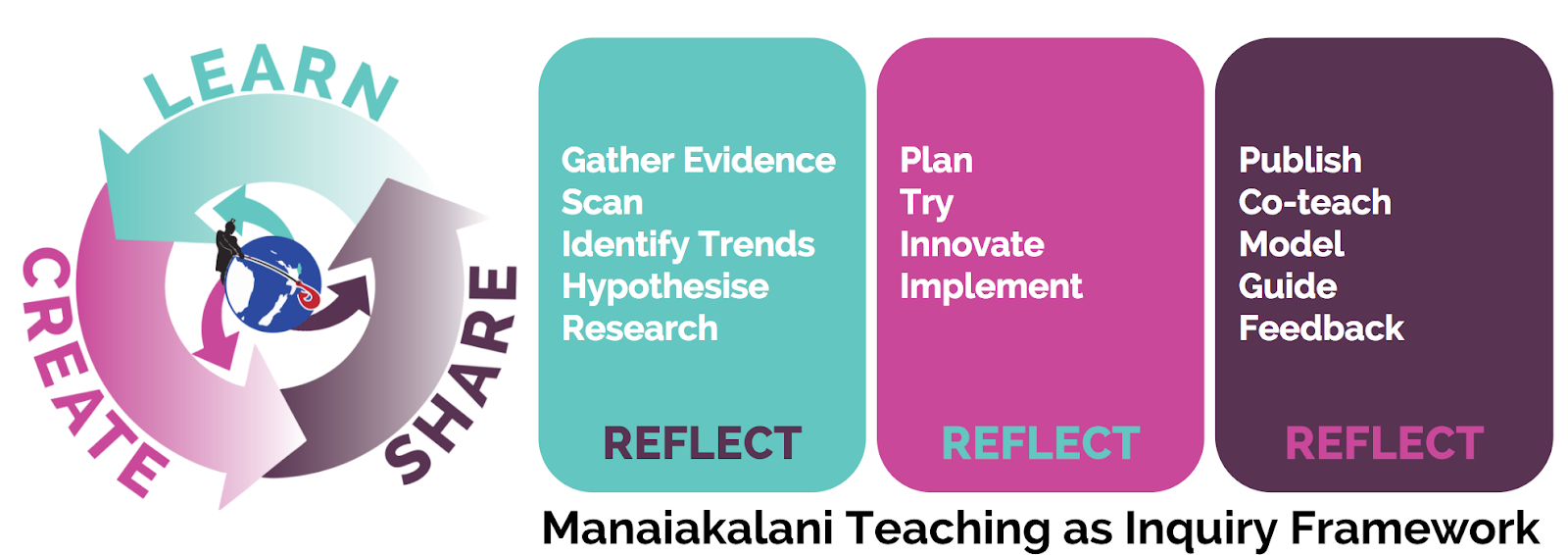
The teaching as inquiry framework I will continue to use in 2018 has been specifically co-constructed for Manaiakalani schools using our familiar Learn Create Share structure.

The elements in this framework share close similarities with other models New Zealand teachers use.


Throughout the year, I will be labelling my blog posts to reflect our Learn, Create, Share structure.


LEvidence
Learn - Gather Evidence
CPlan
Create - Make a plan
SPublish
Share - Publish
LScan
Learn - Scan
CTry
Create - Try new things
SCoteach
Share - Co-teach
LTrend
Learn - Identify Trends
CInnovate
Create - Innovate
SModel
Share - Model
LHypothesise
Learn - Hypothesise
CImplement
Create - Implement
SGuide
Share - Guide
LResearch
Learn - Research
CReflect
Create - Reflect
SFback
Share - Feedback
LReflect
Learn - Reflect


SReflect
Share - Reflect

Monday, 27 November 2017

Spark MIT Reflection Session

Reflection of my learning this year and what I am going to take from it into my teaching for 2018.


This year has perhaps been the most reflective and personally honest year with my teaching since I began teaching in 2000. Looking back, I know that I was beginning to feel ‘burned out’ and ‘stagnant’ in my teaching before leaving the USA.  Although we had adopted and implemented a brand new literacy curriculum (that I helped to write) and a brand new maths curriculum (that I helped train others in our district to teach), I still felt as if my own creativity was being stifled and the demands to be on a certain page in the curriculum at a certain time were limiting my own innovation in my teaching.


When I began teaching in NZ, I had so much to learn about the different classroom models and curriculum. I often felt my previous professional confidence level challenged and I had many internal struggles over my own abilities. However, as my understanding of the curriculum grew and I was provided with opportunities to grow and sharpen my pedagogy I really began to see the opportunities that I now had as a NZ teacher to build my own passions and innovation back into my daily classroom teaching.


When I considered applying for the Spark Manaiakalani Innovative Teacher program for this year, I was very excited to be part of a group that would not only provide an opportunity for me to research and try new ideas with my students, but also provide an avenue for professional conversations and growth for myself.


It is so hard to believe that the year is coming to a close, but there are a few things that I know I will definitely be bringing with me into my 2018 classroom.


  1. Students who are reading at/above grade level will be reading using multimodal texts from among the 4 Woolf Fisher Text Types (Scaffolding, Challenging, Complementary and Student Selected)
  2. Students will be provided opportunities to simply talk (whether it be on a screencast, blog post or in a small group/buddy share) about what they have read.
  3. Students will be encouraged to independently read novels of their choice and be provided time in class to do so in an effort to increase their reading mileage.
  4. Students will be encouraged to dive deeper into topics of interest that are discovered when reading an assigned text...even if they lead to a bunny trail away from the original assignment for a time
  5. I will continue my personal education that will enable me to implement various methods that promote dialogic conversations
  6. I will continue to use the multi-textual database, while promoting, encouraging, and educating other teachers about the benefits of contributing to and using a database of this nature.
Personally, I feel that I have regained my own professional confidence, especially after presenting at various events throughout the year, and being a part of dialogic discussions with colleagues from across our cluster and outreach clusters. Although I know that there will always be room from growth and improvement, I am increasingly aware that what I am doing with my students and the passion I have for it are valuable and I will definitely continue to share my findings (positive and negative) on my professional blog.

2017 Spark MIT ULearn Presentation

This year I have had the amazing opportunity to be part of the Spark Manaiakalani Innovative Teacher program.  We have worked together to formulate, implement and reflect on our Teaching Inquiry which also included an innovation of some sort.

Here is the final screencast video of my presentation from this year's ULearn with updated data from the end of the year testing.


Tuesday, 21 November 2017

2017 Bursts and Bubbles

As an end of the year event, the Manaiakalani Community of Learning held a "Bursts and Bubbles."  Each CoL teacher was given 3 minutes to share their own Impact Burst with the audience.  When preparing for our 'Burst' we were asked to think about four main aspects of our Inquiry.

What happened for the learners?
What evidence do I have for this?
What did I do to make this happen?
Wonderings about what next?

Here is a short video clip of the event which highlights my Impact Burst.

Wednesday, 15 November 2017

Through the Eyes of a Child: A Success Story

This year, I have been inquiring into extending prior knowledge and critical thinking, while promoting dialogic conversations when working with Year 4 students who are reading At/Above their grade level.

One of the students in my class, ended the school year in 2016 with a reading age of 8 years.  This put her "at" the National Standard for Year 3, but it placed her in my middle group for term 1.  This was the group that was working with a very basic version of reading wider and deeper into our cluster wide Inquiry Te Taiao o Tamaki.


However, as the term progressed, it was evident that this beautiful girl was ready to take control of her learning and she was one of the very first to begin working on her assignments from a home computer at night and on the weekends.

As a class, we began reading a few times a week from chapter books, and sharing short summaries on our blogs.  I did not focus on the actual writing of the summary, but really just wanted to get them sharing and talking about what they were reading.  I believe having the freedom to share has helped her discover her own voice when sharing.


As term 2 rolled around, and our beginning of the year testing results came out, she showed tremendous growth, and began reading with the group that was my CoL focus group.  She immediately was able to jump right in and it only took a few weeks to get her to begin talking and sharing her ideas with the rest of the group. This is one area that she has grown tremendously in this year.  


Her progress has continued to be seen in class on a daily basis, and she has become one of the leaders in my focus group...even though she is not part of the actual "focus group of 7."

When looking at her testing data, it is quite interesting to note that she had the exact same Scale Score (33.8 +/- 4) at the beginning and the end of the year, and her STAR Scale Score only increased slightly (from 89.2 +/- 4.5 to 89.9 +/- 3.6).  However, her Running Record Reading Age has increased from 8 years at the end of 2016 to 10.5 years at the end of Term 3 2017.   

She has made 2.5 years accelerated shift in her reading age!

While I am celebrating this, I am also considering some key areas of growth that she will need to continue in as she progresses through to Year 5 next year.  

*Continuing to increase in her confidence when sharing what she has read with others.  
*Making connections across texts and looking deeper into a subject when more clarification is necessary (or personal intrigue prompts)
*Confidently sharing her opinion on a subject and backing it up with related information from within a text.