Showing posts with label LHypothesise. Show all posts

Friday, 12 March 2021

2021 Inquiry Focus

 This year, I have stepping back into a year 3/4 classroom and I have decided to take another look into reading with my students. However, the focus this time around is centered primarily on working with my students in the Orange, Tourquiose and Gold groups (Reading at a Year 2/3 level). 

In speaking with another year 4 teacher at our school during the first Covid Lockdown of 2021, we realised that we both noticed our children reading across these three levels often struggled to express opinions and ideas or deepen their thinking about a text. Generally, these students have basic decoding ability but respond to conversation with one word or short answers. They also do not choose to read without prompting. This led us to believe that the students are not engaging in a meaningful way with the range of literature required to increase comprehension to working at or above their chronological age. 

We were prompted by Rebecca’s presentation during the Manaiakalani Data Staff meeting at the beginning of the year to think about how to increase students' responsibility to think critically about what they have read. This led us to wonder how changing teacher scaffolding from supporting literal engagement with the text to supporting more open provoking questions would we be able to move the responsibility for processing the text at a deep level from the teacher to the student. We also wondered if providing more texts of high interest to the students and creating choice in this process would increase movitivation to read longer novel texts. Lastly, if we were to teach our students to use Google apps to create and share their thoughts, opinions and connections to texts in meaningful ways would that increase critical engagement with texts and support students to think deeper about what they are reading and why they are reading it. 

Ultimately we decided that our Inquiry goals for 2021 are:

1. To increase students comprehension of novel texts

2. To increase motivation to read novel texts

3. to increase discussion and critical thinking across text types

Tuesday, 2 June 2020

Formative Information and Baseline Data

Plan and conduct detailed inquiry into specific aspects of your current teaching that are relevant to the hypotheses you identified in the literature. Inquiring into your teaching should give you:
    1. Formative information about your current strengths and areas for development
    2. Baseline information that you can use at the end of the year  to provide evidence of shifts in teaching
Use multiple tools such as self- or peer-observations, analysis of your class site, student voice. (WFRC #8)


As a Manaiakalani Class on Air teacher, I have the opportunity to routinely capture my teaching on camera. Part of the editing process for my Class on Air episodes requires me to analytically watch the footage that has been captured multiple times to find the best portions of student voice and teaching to share for each episode. Our episodes are also watched and feedback is provided by Anne Sinclair (University of Auckland and Manaiakalani) and other Pt England Class on Air and CoL teachers. 

One of the things that I know I have been working on over the past two or three years is providing more time for students to talk and lead the discussion during our maths sessions. I work hard to create problem solving stories that enable my students to connect with the problem and discuss what they understand before they move into their problem solving groups. Once there students wrestle with the problem, and I roam from group to group providing "nudges" to promote student thinking (How many 5s are there in 100?) and questions about their strategies (Why are you dividing by 5?). It is also very clear throughout the video that I provide adequate opportunities for students to ping pong the conversation from one to another and I only pop into the game when something needs to be clarified or redirected in hope of the students gaining more insight to the topic. When watching the video, it is clear that my students often revert to the more basic names for mathematical operations that they have picked up along the way instead of reaching for the actual name of the concept (ie plussing/adding, taking away/subtracting).

I hope to take a look at a video of a lesson (or have a peer observe) how many times my students use proper mathematical terms and alternative names during a problem solving session.  By adapting and trialing the Four Square and Feature Analysis approaches (as discussed here), I hope to provide my students with more opportunities to recognise the vocabulary of mathematical success. I would also be interested in having a record of the mathematical terms they used kept during the lesson (maybe another video) to see how many of the terms being used are actually terms that we discussed an recorded at some point during the year. 

The edited video from this lesson can be seen below. (click here to view the entire Class On Air episode). After watching the lesson, Anne Sinclair stated, "Loved the shots of the girls struggling with the problem and wrangling with the possible solutions. This is real stuff Angela and what we want to see. It is getting into the heads of the learners to see how they think." I think that's the big thing. Getting into the students' heads to see how they think. Do they have the correct terminology and vocabulary to adequately explain their thinking process. 


As part of this lesson, students also created a video describing their thinking to put on their blogs. Examples from these blog posts can be found here:

This is another place that I will be able to evidence in shift of teaching, By providing students opportunities to share their thinking in a video on their blog, I will be able to compare the number of correct mathematical terms they are able to use in their descriptions.

Wednesday, 25 March 2020

Tools to Gain an Accurate Learner Profile

Describe the tools/measures/approaches you plan to use to get a more detailed and accurate profile of students’ learning in relation to that challenge. Justify why you chose these approaches and tools. (WFRC? #4)

When thinking of my inquiry this year, I have considered the tools/measures/approaches that I plan to use to get a more detailed and accurate profile of my students learning. These tools are:

1. Student Learning Survey: I plan to create a survey to help gain some student voice about their own understanding of their mathematical abilities. I'm interested to know what they like/dislike about maths, and their own understanding about their mathematical ability.

2. PAT Scores: This is a great way to obtain baseline and end of the year data across my class, team and our cluster.

3. Easstle Scores: As a team, we have decided to administer e-asstle pre- and post-tests to our students at the beginning and the end of each designated topic of the curriculum.

4. Teacher observations: During our small group interactions, I am able to monitor student understanding, which allows me to identify individual gaps in student understanding and provides time to help fill in those gaps. I am also able to see how far I can stretch student understanding and raise the roof on their mathematical ability.

5. GLOSS tests: I intend to administer the Gloss test to help gain a deeper understanding of where my students are. I would like to do this (especially for my focus group) just before our Term 2 report and our Term 4 report.

6. IKANN: This is another great tool that I would like to use during terms 2, 3, and 4 to provide students with a clearer understanding of their mathematical ability and growth

Monday, 3 February 2020

My 2020 CoL Inquiry Focus

My 2020 CoL Inquiry Focus:

How can providing opportunities for mathematical vocabulary acquisition strengthen a student’s self-efficacy in maths?

The Manaiakalani Community of Learning is working together on this task using the expertise existing in of our community of learning.

In 2020 for my inquiry I have selected the following CoL achievement challenge: 
Increase the achievement in Years 7-10, in Reading, Writing, and Maths, as measured against National Standards and agreed targets.
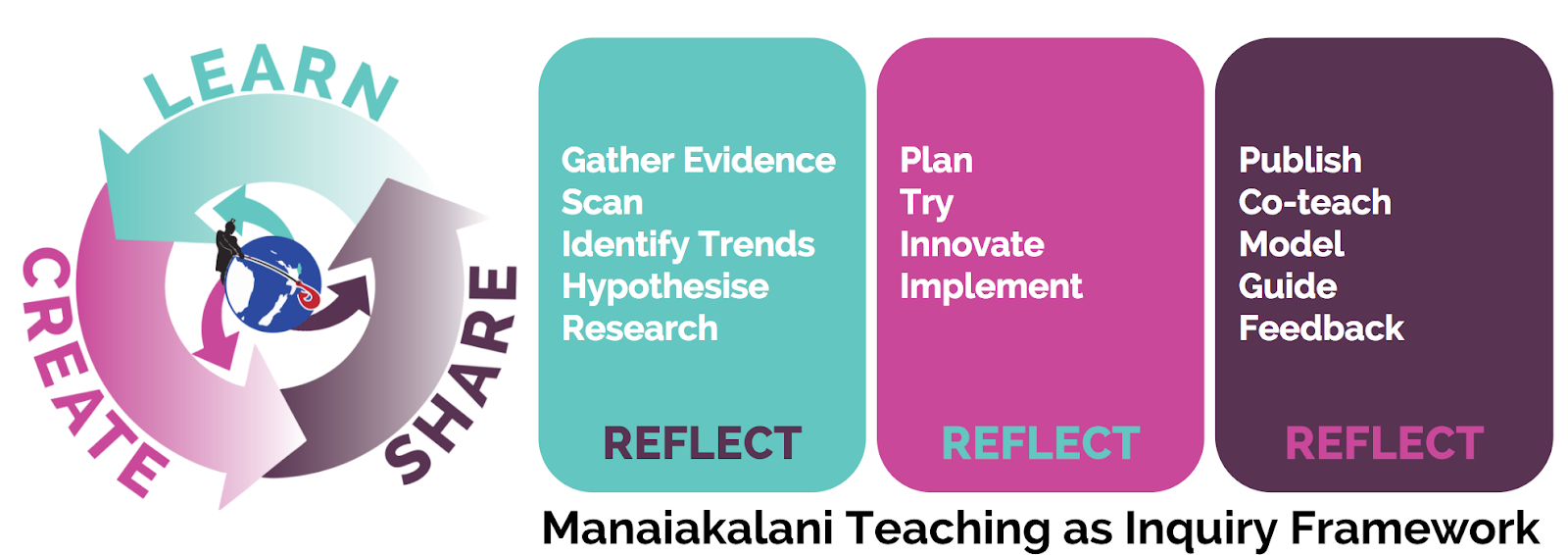
The teaching as inquiry framework I will continue to use in 2019 has been specifically co-constructed for Manaiakalani schools using our familiar Learn Create Share structure.

The elements in this framework share close similarities with other models New Zealand teachers use.


Throughout the year, I will be labelling my blog posts to reflect our Learn, Create, Share structure.


LEvidence
Learn - Gather Evidence
CPlan
Create - Make a plan
SPublish
Share - Publish
LScan
Learn - Scan
CTry
Create - Try new things
SCoteach
Share - Co-teach
LTrend
Learn - Identify Trends
CInnovate
Create - Innovate
SModel
Share - Model
LHypothesise
Learn - Hypothesise
CImplement
Create - Implement
SGuide
Share - Guide
LResearch
Learn - Research
CReflect
Create - Reflect
SFback
Share - Feedback
LReflect
Learn - Reflect


SReflect
Share - Reflect

Tuesday, 28 May 2019

Testing Hypotheses

Explain the hypotheses about teaching that you decided were MOST worth testing, and why. (WFRC #8)

For each of your hypotheses, explain how you will test it and what evidence would support (or refute) that hypothesis. (WFRC #9)

Scaffolding:
Am I scaffolding too much and at the same time, am I removing the scaffold too soon? It is such a delicate back and forth that we must do, especially in a class setting with students working across three curriculum levels?

WHY: Many students in my class, are so used to being able to do things in a step by step process as described and monitored by teachers in the past. Students are not used to self-monitoring their own progress.

TESTING/EVIDENCE: The most immediate way to test this is by observation of independent student work. By providing students with assignments that have the scaffolding in place as a pre-observation and then removing it for a later assignment will provide the easiest way to visualise and assess student achievement. Once it is observed that a task of that nature can be completed without the scaffolding, then move on to the next task type.  I also believe that the effectiveness of this will be seen when analysing student running record results. Many of our learning tasks are created in a way that will allow students to think about a text in a way that is required for the higher level running record tests.  If students are able to make that connection from their assignment to the test question then growth is evident.

Collaborative Sharing Time:
Do I provide my students with time to learn from each other? We spend so much time in class reading about similar topics, but what can I do to provide opportunities for groups to grow wider with their understanding of a learning topic by learning from their peers in other reading groups.

TESTING/EVIDENCE:
Evidence of .this would occur by careful planning on my part and the development of tasks for students to work in across their reading groups. This could provide students with a common language about a subject but depending on which text they have been exposed to they would have different levels of understanding. Students working together collaboratively like this has the potential to create cross-group creative tasks for students to shine with those from higher/lower reading levels.

Monday, 27 May 2019

Addressing Student Learning Focus

Develop a set of hypotheses about patterns in your teaching that could be changed to more effectively address the student learning focus. (WFRC #7)

1. Time Management: Am I expecting too much or too little of my students when it comes to their follow up tasks?
2. Collaborative Sharing Time: Do I provide my students with time to learn from each other? We spend so much time in class reading about similar topics, but what can I do to provide opportunities for groups to grow wider with their understanding of a learning topic by learning from their peers in other reading groups.
3. Scaffolding: Am I scaffolding too much and at the same time, am I removing the scaffold too soon? It is such a delicate back and forth that we must do, especially in a class setting with students working across three curriculum levels?
4. Reading Strategies: Am I offering the right follow up tasks (in a creative way) that allow to students to develop their specific reading struggles?


Thursday, 23 May 2019

Process of Hypothesis Development

Describe your process for developing hypotheses (what you read, who you talked with). (WFRC #6)

Conversations with:

Woolf Fisher Research Centre
-Students across our cluster are making some achievement, however, they still remain below the national norm for their age group.
-Wider and Deeper Reading Models
-Increased Reading Mileage 

Russell Burt-Principal 
-Ongoing Staff meeting discussions about our school reading data and next steps

PES Staff Inquiry Meetings
-Twice a term, we have staff meetings designated to discussing with and gaining feedback from our staff in regards to our 
Team 5 Colleagues
-As a team, our team wide focus in on reading and as a result we have ongoing conversations during our team meetings (Both formal and informal)

2017-2018 COL Bursts and Bubbles
-Listening to the presentations from the CoL Teachers from across Manaiakalani

Professional Development/Reading:

Betsy Sewell (blog post here)
By the time students reach years 6,7, and 8 they have so many gaps that have been created by the inability to know HOW to apply specific reading skills like letter combinations, sounds and words.  What can we do to change the way they are learning? Betsy offers many new strategies that we are implementing at lower levels around the school.

Dr. Janni van Hees (Blog thread here)
During the past few years, I have been able to have multiple sessions with Dr van Hees across the grade levels due to the different classes I have taught. Her messages are always the same (students need to talk more and be talked to using high level vocabulary), but she continually brings new strategies to consider and trial in class. 

What Every Primary School Teacher Should Know about Vocabulary?-Jannie van Hees and Paul Nation


Tuesday, 9 April 2019

Building an Accurate Student Learning Profile

Describe the tools/measures/approaches you plan to use to get a more detailed and accurate profile of students’ learning in relation to that challenge. Justify why you chose these approaches and tools. (WFRC #4)


When thinking about my inquiry this year, the tools/measures/approaches that I plan to use to help portray and accurate profile of student learning in relation to vocabulary acquisition strengthening reading comprehension and promoting student led dialogic conversations are:

1.  Student survey: My hope is that by asking my students to help paint a reading profile of themselves, (likes, dislikes, strengths, weaknesses, etc) I will be able to hopefully plan the best reading tasks/genres/topics and have an idea of where to focus my lessons to help build student interest in a topic

2. PAT Scores: This paints a very quick picture for me as the teacher (and for my students when we go over the results together, which I hope to do early in Term 2) of a student's strengths and weaknesses. It also allows for a clear picture of student achievement at the end of of the year when combined with other data collection.

3. STAR Test Scores: This test allows for a picture of current vocabulary usage to be made for each student. Combined with the PAT test at the end of the year, it contributes to the clear picture of student achievement as well. 

4. BURT Word Recognition Test: After administering this test last year, I realised what an easy tool it is to administer and how it also contributes to that picture of student achievement.  Going through this with the students and allowing them to see what they were able to achieve now and at the end of the year is a quick indicator for them of the daily words they are able to recognise while reading.

5. Running Records: By administering Running Record tests, I am able to see firsthand what an individual's issues are when decoding/comprehending a text.

6. Teacher Observation/Group Interactions: I try to keep adequate anecdotal notes when working with my reading groups. I have begun to keep an "oral reading" log where I quickly note things I notice during our reading sessions in addition to my normal teacher plan reflections. 

Tuesday, 19 March 2019

The Catalytic Issue and my Hunches

Image result for catalyst
Explain why you judge this to be the most important and catalytic issue of learning for this group of learners this year. (WFRC #3)

This year I will be inquiring into promoting vocabulary acquisition to strengthen reading comprehension and stimulate student led dialogic conversations.  This is the most important issue for my group of learners as indicated by our school wide reading data and the 2018 Manaiakalani Reading data because as the years go on for Manaiakalani students the gap between our students and the NZ norm increases tremendously as they reach years 7-10.

I believe that based on the Professional Development we have received over the past few years from Dr. Janni van Hees focusing on Language Acquisition and the discoveries made by previous CoL teachers are key to building the link from primary to intermediate and then again from intermediate to high school.  I am very interested in seeing if the students from my focus group are able to grow in their understanding of unpacking topic rich vocabulary to ultimately lead to a growth in self-efficacy to promote dialogic conversations that will in return create a "want" in my students to independently go "Wider and Deeper" in their reading, as previously unpacked by Dr Jesson and Dr McNaughton.

Some possible wonderings that I am considering as I discover the catalytic issue of learning this year are:
-Have students at this age have lost the confidence to share with their peers? What can I do to promote student self efficacy in my classroom?
-Is it true that my students are not actively reading for pleasure?
-Do my students know where to begin to read for pleasure?
-How can I effectively model and recreate useful strategies for students to use to gain vocabulary knowledge while reading?
-What are the level of texts used in the high school reading program?
-What does the high school do to promote reading comprehension? What do their follow up tasks look like?
-Could introducing NCEA level vocabulary purposely in years 7-8 help to bridge the gap between intermediate and high school?

Tuesday, 5 February 2019

My 2019 CoL Inquiry Focus:
“Promoting vocabulary acquisition to strengthen reading comprehension and stimulate student led dialogic conversations.”

The Manaiakalani Community of Learning is working together on this task using the expertise existing in of our community of learning.

In 2019 for my inquiry I have selected the following CoL achievement challenge: 
Increase the achievement in Years 7-10, in Reading, Writing, and Maths, as measured against National Standards and agreed targets.
The teaching as inquiry framework I will continue to use in 2019 has been specifically co-constructed for Manaiakalani schools using our familiar Learn Create Share structure.

The elements in this framework share close similarities with other models New Zealand teachers use.


Throughout the year, I will be labelling my blog posts to reflect our Learn, Create, Share structure.


LEvidence
Learn - Gather Evidence
CPlan
Create - Make a plan
SPublish
Share - Publish
LScan
Learn - Scan
CTry
Create - Try new things
SCoteach
Share - Co-teach
LTrend
Learn - Identify Trends
CInnovate
Create - Innovate
SModel
Share - Model
LHypothesise
Learn - Hypothesise
CImplement
Create - Implement
SGuide
Share - Guide
LResearch
Learn - Research
CReflect
Create - Reflect
SFback
Share - Feedback
LReflect
Learn - Reflect


SReflect
Share - Reflect

Tuesday, 13 February 2018

Hunches: What do I see?


-Oral reading of novel at/above grade level everyday (straight forward reading...with quick pull apart after)
-Implementing talk moves strategies in Literacy while promoting discussions in pairs, small group and whole class

-Begin by reading Jannie’s book (see Russell) for possible ideas to implement

- Integration with Writing???

Problem Defined:
How can we use dialogic discussions to expand vocabulary usage while strengthening reading comprehension?

Possible Hypotheses:

Students need to develop confidence applying prior knowledge and vocabulary to new situations and experiences and understand that learning from one year (or one term) to another builds upon the previous. In order to provide opportunities for this to happen:
  • Students need to be exposed to higher level vocabulary in a variety of ways
  • Students need to be exposed to words in a variety of settings linking them together
  • Students need to develop the confidence to talk in a large group setting in order to hold a beneficial dialogic discussion linking vocabulary, prior knowledge and information from a text
  • Students need to understand the elements of a beneficial dialogic discussion, using Talk Moves

Evidence of Need:
According to the Wolf Fisher Research Centre, our students learn by talking about what they are learning (dialogic conversations).  However, over time students often fail to use effective vocabulary to explain their thinking and link their learning from one year to another. 

Data Gathered:
  • Student PAT and STAR results-Nov 2017 
  • Student PAT and STAR results-Feb 2018
  • Running Records-Nov 2016 
  • 2017 Teacher OTJ-Reading
  • Reading previous student Blog posts 
  • In class micro group discussions

Next Steps:
  • Read Dr Jannie van Hees' book and decide how/what to apply to my classroom setting
  • Explore ways to incorporate the use of Talk Moves into daily discussions
    • Directly Model/Teach how to use each Talk Move
  • Scan the class with a Google Form survey to formulate genre/topic interests 

Thursday, 25 January 2018

2018 Manaiakalani Teaching As Inquiry Framework

My 2018 CoL Inquiry Focus:
“Using dialogic discussions to expand vocabulary usage while strengthening reading comprehension.”

The Manaiakalani Community of Learning is working together on this task using the expertise existing in of our community of learning.

In 2018 for my inquiry I have selected the following CoL achievement challenge: 
3. Lift the achievement in reading for all students, with a particular focus on boys and Māori students (both genders), years 1-13

The teaching as inquiry framework I will continue to use in 2018 has been specifically co-constructed for Manaiakalani schools using our familiar Learn Create Share structure.

The elements in this framework share close similarities with other models New Zealand teachers use.


Throughout the year, I will be labelling my blog posts to reflect our Learn, Create, Share structure.


LEvidence
Learn - Gather Evidence
CPlan
Create - Make a plan
SPublish
Share - Publish
LScan
Learn - Scan
CTry
Create - Try new things
SCoteach
Share - Co-teach
LTrend
Learn - Identify Trends
CInnovate
Create - Innovate
SModel
Share - Model
LHypothesise
Learn - Hypothesise
CImplement
Create - Implement
SGuide
Share - Guide
LResearch
Learn - Research
CReflect
Create - Reflect
SFback
Share - Feedback
LReflect
Learn - Reflect


SReflect
Share - Reflect