Showing posts with label CPlan. Show all posts

Thursday, 13 August 2020

What Evidence?

*Describe how you will collect information about the implementation of your changed practices/intervention. (WFRQ? #12)

*Identify informal/formal ways you are monitoring the effects of your changed practices/intervention on learner outcomes. Explain the reflections/tweaks you are making along the way. (WFRQ? #13)

*Describe how you will keep a record of each of the above in a manageable way. (WFRQ? #14). 


It is important to remember that during the Inquiry process that you are ultimately looking at the things that YOU the TEACHER can do to make YOUR teaching practice more effective. 

The focus of my 2020 Inquiry is "How can providing opportunities for mathematical vocabulary acquisition strengthen a student’s self-efficacy in maths?" 

Although my intended route has been altered some due to the Covid-19 Lockdowns, and changes made in our school timetable as a result, I have been able to implement the following interventions in my teaching. Due to the nature of the questions asked by the WFRC, I decided it was best to link my responses in one blog post.

 
1. Very specific purpose to our whole class problem solving and small group micro teaching sessions. In my lesson plans (DATs), I try to specifically think about what I want to do with/focus on with each maths group prior to our problem solving sessions. In doing this, I am able to clearly know (and remain on task) with the mathematical concepts and vocabulary that I am trying to work on with that group of students. In addition to my actual DAT plan, I also keep rather in depth reflection notes often indicating where certain students have successes and failures, in addition to thinking about my next steps as a teacher. 
                         

2. I started out the year, providing students with "A Closer Look" learning tasks. Before beginning a new section of a unit, I decided to try front loading the students with the vocabulary that they should know
(at Level 4) in order to be successful working on that specific topic. This is an idea that I based on the work we had done as a team last year with Dr. Jannie van Hees around Genomics and our Literacy program. Once students have had a closer look at this vocabulary, I plan my problem solving questions using these specific vocabulary words in a way that will get students using them as they discuss their problem solving strategy and solution. 


3. I have been capturing student voice, and my own teacher voice, through video recording our lessons and monitoring the amount of times students use, are prompted to use and I, as the teacher, use proper mathematical vocabulary. An example of this can be found on my blog post entitled, "Formative Assessment and Baseline Data"

4. The last thing I plan to do differently is implement the use of some strategies that I read about earlier this term: the Four Square and Feature Analysis approaches (as discussed here).  Unfortunately, I don't feel confident implementing these new strategies while we are Distance Teaching. My hope it to be able to implement the use of these strategies once my class is back in the classroom as a regular Level 2 class.  Students will be able to keep a personal record of these tasks on their class blogs. 

In order to keep a record of everything, I will be using student blog posts, reflection and DAT spaces on my weekly lesson plans, and learning tasks monitored and filed appropriately in my Google Drive. Student voice will be collected through student blog posts and in class videos that I record during specified lessons. Once I find something worth sharing, I will be publishing regular updates on my blog, which  provides a quick and reliable place to share change in my teaching and student shift data. I also keep regularly updated spreadsheets that monitor student shift (PAT, eAsstle, etc) and my own anecdotal notes on student progress. 

Monday, 10 August 2020

My Theory of Action

 Restate your inquiry question and your theory of action/chain of events (WFRC#11)

My inquiry question for 2020 is:

How can providing opportunities for mathematical vocabulary acquisition strengthen a student’s self-efficacy in maths?

My Theory of Action:

A Chain of Events – Gonzo Opera

As a year 7/8 teacher, I feel that there is often a struggle with our students who do not have the necessary mathematical vocabulary to back the skills that they are acquiring. As a result, students are often at a loss for what to say to describe their mathematical thinking and reluctant to openly share with their peers. We have also noticed that students do considerably better from year to year on easttle tests than they do when taking the PAT Maths test. I wonder if this is due to the open subject matter of the PAT so students know more directly what type of problems they are solving. 

The changes I am making to my teaching to improve their outcomes are still being implemented at this time, especially due to our change in teaching during the Covid-19 lockdown. However, prior to the lockdown, I was using a "Looking Closer" format embedded into my learning tasks that provided students with an opportunity to interact with new grade level appropriate mathematical vocabulary. In the past, students have been primarily taught at the level of curriculum that they were working at. This caused a larger gap to develop with student mathematical vocabulary because students were not using grade level appropriate terminology for mathematical concepts. For example, students often still come into Year 7/8 saying things like "I got the answer 13 from plussing 10 and 3" instead of "I got the answer 13 from adding 10 and 3." 

As we prepare to enter into a more "normal" phase of teaching and learning, I am interested in implementing some of the ideas and concepts discussed on the professional reading that I have recently done in the past few weeks. These include, the Four Square and Feature Analysis approaches (as discussed here).

The reasons why I think these changes in my teaching will be effective to my learners are that they will provide a more solidified understanding of the terms used to describe various mathematical processes and concepts. Students will be provided with a visual reminder of what those words and phrases mean. Students will also be given multiple opportunities to put their new vocabulary to use describing their problem solving process. 

Monday, 3 February 2020

My 2020 CoL Inquiry Focus

My 2020 CoL Inquiry Focus:

How can providing opportunities for mathematical vocabulary acquisition strengthen a student’s self-efficacy in maths?

The Manaiakalani Community of Learning is working together on this task using the expertise existing in of our community of learning.

In 2020 for my inquiry I have selected the following CoL achievement challenge: 
Increase the achievement in Years 7-10, in Reading, Writing, and Maths, as measured against National Standards and agreed targets.
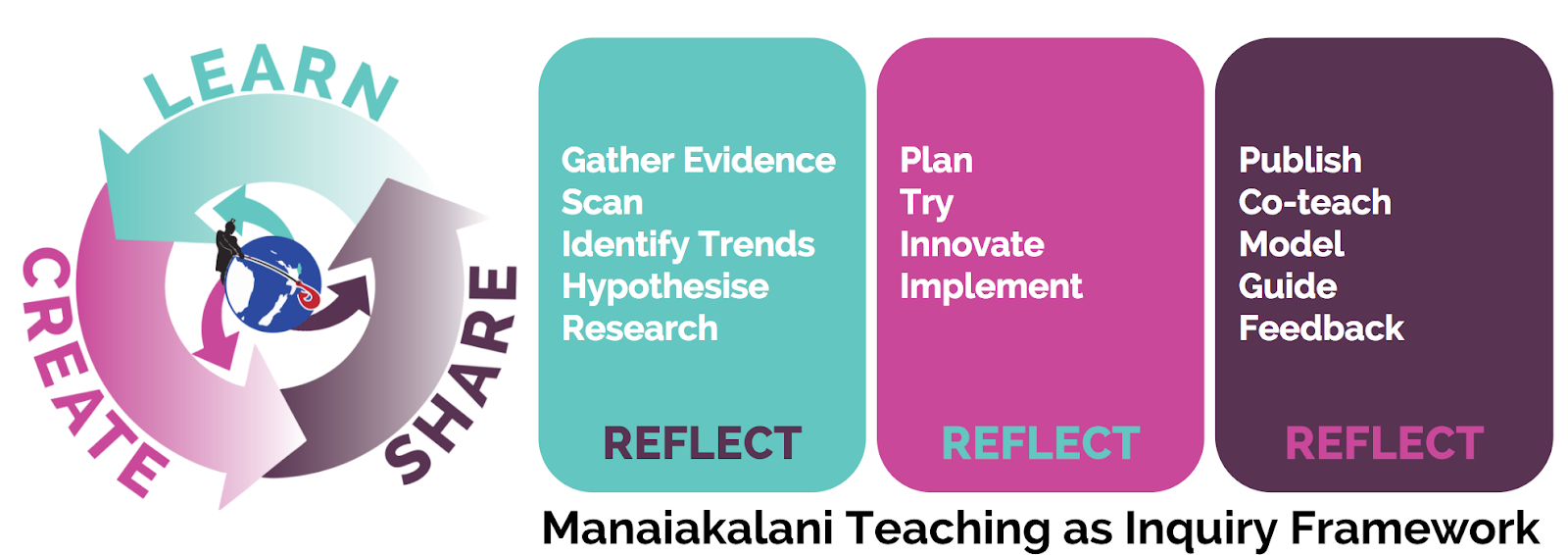
The teaching as inquiry framework I will continue to use in 2019 has been specifically co-constructed for Manaiakalani schools using our familiar Learn Create Share structure.

The elements in this framework share close similarities with other models New Zealand teachers use.


Throughout the year, I will be labelling my blog posts to reflect our Learn, Create, Share structure.


LEvidence
Learn - Gather Evidence
CPlan
Create - Make a plan
SPublish
Share - Publish
LScan
Learn - Scan
CTry
Create - Try new things
SCoteach
Share - Co-teach
LTrend
Learn - Identify Trends
CInnovate
Create - Innovate
SModel
Share - Model
LHypothesise
Learn - Hypothesise
CImplement
Create - Implement
SGuide
Share - Guide
LResearch
Learn - Research
CReflect
Create - Reflect
SFback
Share - Feedback
LReflect
Learn - Reflect


SReflect
Share - Reflect

Tuesday, 13 August 2019

What Evidence?

Describe how you will collect information about the implementation of your changed practices/intervention (so it is clear what you doing differently). (WFRC 10)

Describe how you will keep a record of each of the above in a manageable way. (WFRC 11)

We were challenged by the Wolfe Fisher team during our last CoL meeting, to spend some time thinking about how we have been recording how WE as the TEACHER have changed our own practice.

When we began the journey earlier this year, my initial focus for my inquiry was, "Using dialogic discussions to expand vocabulary usage, while strengthening reading comprehension." In order to make this happen, I have been working very hard to change my teaching practice in a few specific, yet meaningful ways:

1. Very specific purpose to our oral reading sessions. In my lesson plans (DATs), I try to specifically think about what I want to do with/focus on with each reading group prior to reading, while reading and after reading. In doing this, I am able to clearly know (and remain on task) with the literary elements/vocabulary that I am trying to work on with that group of students.

2. I have been providing student led methods of discovery for vocabulary acquisition (Deep Diving). I have been strategically spending time working through what a new word means instead of simply having students take one random guess while reading and then telling the group the true definition or modelling how to conduct a "define:" smart search.  
I now grab a piece of paper (or on the whiteboard) and write the word in a bubble before turning the pen/marker over to the group to add what they think they know about the word.  Students then asked to continue adding to the word cloud to build their understanding of the word as they continue their reading or watch the assigned video.  Students then create a digital model of the deep dive to post on their blog and link to my spreadsheet. There are also been times, when we have simply stapled the paper copy on the classroom wall. 


3. After working with the DMIC mentors, one of the things that I have been trying to pull into my teaching this year is strategically talking less while encouraging the students to talk more. I do this generally by providing them with the topic (video, paragraph, question, etc) for discussion and then providing them with 30-60 seconds of "prepare" time to formulate what they are going to share. They then have 30-90 seconds to "share" their information with a partner before we come back together and "report" back to the whole group/class.  Keeping an accurate record of this is something that I have not actually considered until this past week.

So far, as the reporting back has occurred I have created a mind map/brainstorm/note taking model for the students to use when completing future learning tasks. The notes that I put on the board are often added to or modified as more students share.  The whole class notes are photographed and put in a folder in our class Google drive.

After our PD session with Aaron and Hanna, I am now thinking that perhaps I should set up a video camera more often during my class discussions simply to capture student interactions, voice, and sharing.

.

Tuesday, 26 March 2019

Say More. Tell the Detail.

As part of our CoL meeting last week, we heard from Dr. Janni van Hees and she shared with us some practical ways to get our kids using higher level vocabulary.  One of the strategies she shared with us was referred to as Say More. Tell the Detail.

I decided to try this strategy with my Literacy class this week with the hope of linking the concept to our writing assignment from last week.

Dr. van Hees suggested showing students a simple statement like:

A bird flew into our house.

After showing this to the class, have a discussion about what else we could include as the author to allow the reader to understand (and see) exactly what the author was trying to say. Then, show them this improved paragraph. 

A bird flew into our house. We had a window open and it just flew in. It was super scared 'cos it felt trapped.

Taking this concept into consideration, I knew from the writing samples I had recently scored that many of my students were not including detail of this type in their writing. I have also observed that my students were not used to sharing colourful language when brainstorming and looking at a picture before they begin writing. As a result, I decided to focus my writing lesson this week on painting a picture with our words. 

We began by looking at this picture and sentence:
The sun low over the horizon
I saw the sun.

I then asked the class what else they wanted to know.  They came up with things like, 
  • When did you see the sun?
  • Where did you see the sun?
  • How did you see the sun?
We then discussed ways that we could add personification to the description and what other descriptive words they could use when talking about this picture.

We pulled together this list:

  • When: On my way to school this morning
  • Where: over the river
  • How: rays through the clouds
  • Figurative Language: Personification the sun is greeting me
  • Descriptive words (adjectives): *sparkling river  *bright rays *morning sun
Then, we were able to construct the following detailed sentence.

This morning, on my way to school, I looked over the sparkling river and saw the bright rays of the morning sun shining through the clouds to greet me as I started my day.

Students have been provided with three more pictures to consider while making sentences that paint a picture. I am hoping as a result of this we will begin to see words and phrases from the Goldilocks zone emerge when we are brainstorming for our digital word bank prior to starting our writing tasks each week.


Tuesday, 5 February 2019

My 2019 CoL Inquiry Focus:
“Promoting vocabulary acquisition to strengthen reading comprehension and stimulate student led dialogic conversations.”

The Manaiakalani Community of Learning is working together on this task using the expertise existing in of our community of learning.

In 2019 for my inquiry I have selected the following CoL achievement challenge: 
Increase the achievement in Years 7-10, in Reading, Writing, and Maths, as measured against National Standards and agreed targets.
The teaching as inquiry framework I will continue to use in 2019 has been specifically co-constructed for Manaiakalani schools using our familiar Learn Create Share structure.

The elements in this framework share close similarities with other models New Zealand teachers use.


Throughout the year, I will be labelling my blog posts to reflect our Learn, Create, Share structure.


LEvidence
Learn - Gather Evidence
CPlan
Create - Make a plan
SPublish
Share - Publish
LScan
Learn - Scan
CTry
Create - Try new things
SCoteach
Share - Co-teach
LTrend
Learn - Identify Trends
CInnovate
Create - Innovate
SModel
Share - Model
LHypothesise
Learn - Hypothesise
CImplement
Create - Implement
SGuide
Share - Guide
LResearch
Learn - Research
CReflect
Create - Reflect
SFback
Share - Feedback
LReflect
Learn - Reflect


SReflect
Share - Reflect

Monday, 7 May 2018

A Formative Assessment


In response to the presentation by Dr. Aaron Wilson (WFRC) last week, I spent some time today reflecting on a few key areas that he included as important when formatively assessing our own Teaching Inquiry.  

Thursday, 25 January 2018

2018 Manaiakalani Teaching As Inquiry Framework

My 2018 CoL Inquiry Focus:
“Using dialogic discussions to expand vocabulary usage while strengthening reading comprehension.”

The Manaiakalani Community of Learning is working together on this task using the expertise existing in of our community of learning.

In 2018 for my inquiry I have selected the following CoL achievement challenge: 
3. Lift the achievement in reading for all students, with a particular focus on boys and Māori students (both genders), years 1-13

The teaching as inquiry framework I will continue to use in 2018 has been specifically co-constructed for Manaiakalani schools using our familiar Learn Create Share structure.

The elements in this framework share close similarities with other models New Zealand teachers use.


Throughout the year, I will be labelling my blog posts to reflect our Learn, Create, Share structure.


LEvidence
Learn - Gather Evidence
CPlan
Create - Make a plan
SPublish
Share - Publish
LScan
Learn - Scan
CTry
Create - Try new things
SCoteach
Share - Co-teach
LTrend
Learn - Identify Trends
CInnovate
Create - Innovate
SModel
Share - Model
LHypothesise
Learn - Hypothesise
CImplement
Create - Implement
SGuide
Share - Guide
LResearch
Learn - Research
CReflect
Create - Reflect
SFback
Share - Feedback
LReflect
Learn - Reflect


SReflect
Share - Reflect

Friday, 28 July 2017

Teaching as an Inquiry Framework

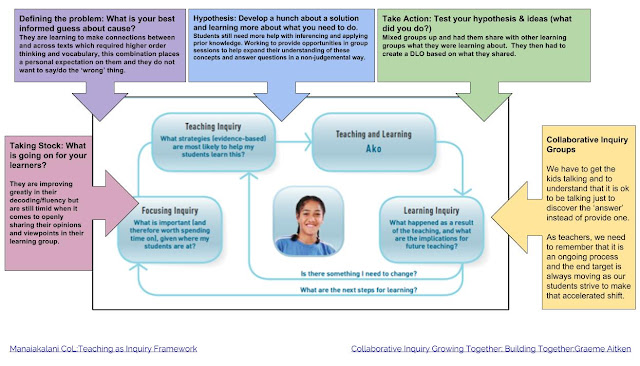
We have now reached the halfway mark of the school year, and as part of our first CoL meeting of Term 3 we were asked to spend some time reflecting on where we are with our on Teaching as Inquiry Framework.  The graphic below was provided for us to fill out as we collected our thoughts before meeting with our CoL Achievement Challenge groups.  
https://docs.google.com/drawings/d/1nLH5GX0NwEaRcQr0BVvM0cC6_g-pEb4k5TPEZhLzNjo/edit?usp=sharing

By sharing our hunches, successes and failures with our colleagues from across the CoL we are given an unique opportunity to learn from and be encouraged by others who are striving to achieve a common goal within their own classrooms. 

Wednesday, 7 June 2017

Create: Making a Plan for Inquiry

Who are my learners and what are their goals?
I have been having an amazing year working with a group of year 4 students who began the year reading from Levels 23-28 to raise their roof on their personal reading achievement.

What have I been doing?
I have been working with a selected group of students from my literacy class (those with a reading age of 8 and above) to provide opportunities to read multimodal texts that support a learning topic (generally the school wide student Inquiry/Topic focus).  Students have really enjoyed reading on their Chromebooks different text types provided at various learning levels to further their understanding of the designated topic.  I have been trying to provide texts for my students as described to us by the Woolf Fisher Research Centre (in the diagram below) in order to increase reading knowledge and foster dialogic conversations in our learning groups.


What I need help with?
I am continuing to find opportunities to engage students in dialogic conversations before, during and after reading, especially those who tend to shy away from sharing in a group setting.  I need to remember to record my group lessons more often in an effort to share (and learn from) my successes, and failures.

How do I document if a strategy is working?
The easiest way to do this is simply by teacher observations.  Listening to my students while they are interacting in their teaching group discussions, and when they are off working independently will give immediate feedback.  However, utilising student blogs and Hapara Dashboard to monitor their learning tasks during the week will also provide evidence of understanding.  The main thing for me to remember is to provide my students with learning tasks that require them to think outside the box and utilise what they have learnt from all modes of the text.