Tuesday, 23 June 2026

Term 2 Inquiry Update


At this point in the year, I am so proud of the progress that my Teir 2 children are making. It is quite evident that the extra small group time they are receiving in their tier 2 group, as well as the work they are doing in class is making a massive difference in their reading fluency and word recognition. As I prepare for Running Record testing during the next few weeks, I am excited to see the progress of these children and to see what my next steps in teaching might be as we progress through the middle of the year. 


Now that we have concluded our Running Record testing I am very proud of the progress these children have made. After consulting with their tier 2 teachers, I have decided to move them from reading BSLA books to the PM books to better equip them with the comprehension skills and ability to complete learning tasks for their level. 


Moving forward, I would like to have my focus be the group reading at Turquoise/Purple to better equip them to complete work at this level across all subjects and to improve their comprehension strategies when reading more involved texts before the end of the year. I would really like to see these children move to silver by the end of the year so that they are no longer 2+ years behind but rather only one year behind moving up to year 5.


Wednesday, 25 March 2026

2026 Inquiry

At the end of 2025, I began training as a year 4 teacher in BSLA. As my training comes to an end this term, I am looking at how I can better implement small group teaching using the BSLA readers and teaching processes with my Year 4 Tier 2 students. 

During the first portion of the year, I am going to focus on working with these tier 2 groups through my modeling of target graphemes and how it directly translates into student accuracy during the word-blending phase of book introduction. 

My overall Inquiry Question is: 
How effectively am I using 'Vocabulary Elaboration' and 'Story Grammar' mapping to prepare students for the specific linguistic demands of the new text?

My hope is that through my whole class taumata I can introduce the strategies of vocabulary elaboration and story grammar mapping that will directly fall into completed and successful independent tasks with the children. I do recognise that those in my tier 2 groups will require a little extra assisstance as the year progesses, which is why I will be placing some focus on my small group interactions with them a well. 


Tuesday, 25 November 2025

Vosaic Observation Term 4

 This year, I have been focusing on my maths teaching while implementing our new maths program Prime Maths. My students are doing very well and we worked hard to understand and implement this new focused way of teaching maths. 


For my final Vosaic observation of the year, my question was: Has the teacher implemented a lesson that allows students to explore mathematical concepts, using manipulatives as tools for discovery, while also facilitating meaningful mathematical discussions and problem-solving? 

The progam had this to say about my lesson: 

Yes. The teacher implemented a lesson that uses manipulatives for student exploration and supports mathematical discussion and problem-solving.

  • Manipulatives used as tools for discovery: The teacher instructs pairs to each take 10 counters and to combine and split them to explore division. The class physically combines to make 20 counters and then splits into two groups, and later students are encouraged to use counters or draw on whiteboards/MacBooks for practice.
  • Exploration of mathematical concepts: The teacher models and elicits conceptual understanding of division as “splitting into groups,” connects division to multiplication as its inverse, and demonstrates multiple symbolic forms of division. Concrete examples are used (20 rings into 2 groups → 10 each  ; 9 seahorses into 3 groups → 3 each ; 20 chicks into 4 nests → 5 each at.
  • Facilitation of mathematical discussion and problem-solving: The teacher prompts pair talk and checks students’ grouping, asks guiding questions, asks students to write number sentences and explains how to record division, and has students both draw representations and use facts to check answers .
  • Opportunities to justify/check answers: The teacher models checking division via multiplication and has students demonstrate by counting or using multiplication facts.

Evidence-based moments to highlight

  • Moment 1 (manipulative exploration): Students combine counters and split into two groups to discover 20 ÷ 2 = 10.
  • Moment 2 (conceptual discussion and representation): The teacher connects division to multiplication and shows multiple symbolic representations and a fraction connection.

Conclusion

Overall, the transcript shows a lesson structure that integrates manipulatives for hands-on discovery, prompts partner discussion, models representation and notation, and reinforces conceptual understanding and checking strategies—supporting meaningful mathematical exploration and problem-solving.

At the beginning of the year, I was most worried about how to best implement the use of manipulatives to springboard conceptual understanding and mathematical vocabulary development. Now, I fully believe that take the time to read the teacher notes and follow them as a guide for my maths lessons I can easily achieve this in my lessons on a daily basis. 

The summary of my lesson provided me with more feedback that I will consider moving forward into next year, primarily providing more opportunites for students to talk during our math sessions especially during the we do/you do portions of our lessons. 

Friday, 22 August 2025

Writing with Gemini AI

One of the things we have been thinking a lot about is how we include our Maniakalani Learn, Create, Share pedagogy with our BSLA program. 

This week, my Literacy class was reading the story "Staying Afloat."  We have been working to write complete sentences using lots of good detail and description. After we discussed the elements of the story, the class had 10 minutes to write their own retell. Then, they were shown how to put their retell into Gemini AI to get a picture based on their writing. They learnt how to modify their writing to include the best detail to get an image that properly illlustrated the main idea of the story. 

 Here is an example that was written by a student in class: 

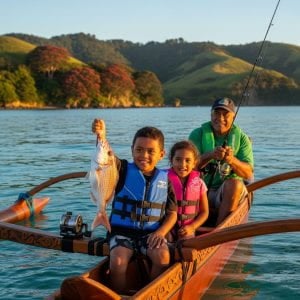
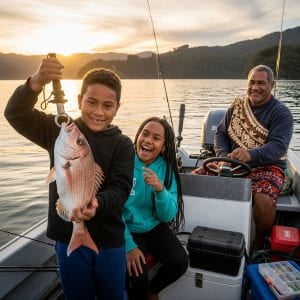
  One day kele and Vika, also granddad, were going on a boat. Granddad told them to wear a life jacket but kele didn’t want to wear one so he told how a boy who was in tonga,  but strong  fell into  the sea. Kele gasped so he had to wear one at last. When they were fishing kele fell into the water too but grandad could get him in time. At last Kele was out  grinning because he got a snapper and said who is the best fisher now!! Here are our first two tries at an image. 

The first image didn't show grandad or the sister Vika and it didn't show Tongan children so we made a few changes (as seen in the above paragraph).


 But, we were still not happy because there were no life jackets in the second photo and they were in a motorboat. 

So we got back to work and this is how we modified it to get the best photo from Gemini: 

 One day a Tongan family went fishing in New Zealand. Kele, his sister Vika, and granddad, were going onto Grandad's vaka. After putting on his green life jacket, Granddad told them to put their life jackets on. Vika put on her pink life jacket but Kele didn’t want to wear one. Grandad told how as boy growing up in Tonga, he fell into the sea. Kele gasped so he had to wear one at last. When they were fishing kele fell into the water too but grandad could get him in time. At last Kele was grinning because he got a snapper with his blue life jacket on!!

Monday, 4 August 2025

BSLA Conference Day 1

 Over the next three terms, I will be working through the University of Cantebury to become a trained BSLA (a structured literacy approach for reading) teacher. I am excited to continue this process as I spent some time during term 1 trialing the year 4 program before it was released to be used more widely. 

Here is a brief overview of the notes that I took during day 1 of our conference at the Waipuna Conference Centre. 

Day 1:


Morning Introduction: 

10 weeks of teaching (term ¾?)

UN: Target Goal 4.6 All youth achieving literacy by 2030

Children’s literacy achievement is strongly related to educational success and well-being

-need to accelerate learner needs

-extend exceptional learning capacities

Systematic and explicit teaching approaches (IDA 2019) evidence based approaches for dyslexic students

Year 4-8 Breakout

Oral Language         Reading         Writing

Communication Skills Word Recognition Transcription

Language and Reading Comp. Comp. Composition

                Critical Analysis         Writing Processes

Assessment; Dibels ORF,  Dibels Maze (ASAP and again at 20 weeks) and PhoM

Excellence in Assessment Practices 

Valid and reliable assessments to monitor students’ growth and celebrate success

In 10 weeks….who is tracking who needs support who needs extending?

Focus on what children can achieve and then identify next steps for learning.

Why are we using the assessments we are using? Above: Guides for Assessment Selection 

BSLA Assessment Website: still be developed for yr 4-8

Year 4-8 Assessment:

Oral Reading Fluency (ORF):

  • Assess students’ ability to read connected text with speed and accuracy

  • 60 seconds measured individually

  • Scoring=words correct per minute and accuracy percentage

Maze: 

  • Assess students’ ability to reason through a passage and select the most appropriate word to fil in blanks

  • 3 minutes measure administered individually or in groups

  • Scoring= number of words correct minus ½ the number of words correct. 

Grade Administered Should be:  Year - Minus 1 year

Middle passage for baseline and end for the 20 week assessment

After analysing all testing data (colour coding)

Then total number of green & Blue scores 

At least 50% of the whole class teaching at year level

What assessments should we do in the next week or two? ORF and MAZE then compare with PAT scores keeping in mind current reading levels 

PhoM Assessment

Purpose: 

-Track progress over time before/after taumata (and after 30 weeks of teaching)

-3 taumata a year

-Recognise strengths in knowledge and next steps for learning

-Ensure teaching remains responsive and targeted

Assessment Schedule:

For kids who score in the “red band” give them the year 3 spelling screener and input their data into the assessment website and follow the action plan there (score analysis)


Monday, 14 July 2025

Shameless SWAG

 I've titled this "Shameless SWAG" because quite honestly that is exactly what it is. What else do you do with a "badge" you earn when you're a Manaiakalani teacher? 😆 

In all honesty, I'm about to begin training for BSLA (Better Start Literacy Approach) through the University of Cantebury and as we begin our online course there was an 'Online Essentials' mini-course that we were asked to complete to familiarise ourselves with the course layout across their digital platform, and other key information about the school and it's values and policies.

So, with that said, here is my badge!


Monday, 2 June 2025

Create Mini-Games with Gemini

 During our Manaiakalani Create teacher only day, I spent some time learning how to create mini-games with Gemini. It was a lot of fun and we were able to spend some time debugging through the AI prompt to make things run smoother.  To access each game click on the photo below. 

The first game I created was a Tetris-style multiplication game. In order to earn peices to play on tetris board, the play must accurately answer the multiplication facts.


The second game, (actually the first one I had a go with) was a solar system trivia game. It is very basic (game-wise) but the questions are pretty impressive given the parameters I set for the game in the AI.