Showing posts with label SPublish. Show all posts

Thursday, 19 November 2020

Bursts and Bubbles 2020

This year's Burst and Bubbles was a lot of fun. It was great to hear what everyone was doing and how the classroom pedagogy had changed due to the Covid restrictions we faced during the year. Please read my Burst and Bubbles report below or click here to see the video of my presentation.  


The catalytic aspect of student learning my inquiry focused on this year was
 providing opportunities for mathematical vocabulary acquisition to strengthen a student’s self-efficacy in maths.

I identified this as my focus when I noticed that many of my students were beginning to happily have dialogic conversations in literacy but were finding it difficult to carry that same level of conversation across to maths. Also, during my create based learning tasks students were asked to create videos of themselves discussing their thought process behind their problem solving strategies. Very quickly it became apparent that many students were unable to use the correct mathematical vocabulary when describing their solutions. 

To build a rich picture of my students’ learning I used PAT, strand based Easttle and GLOSS test results, personal observations/reflections, student voice surveys, and video recorded maths lessons and student interactions throughout the year.

The main patterns of student learning I identified in the profiling phase were that many of my students didn’t necessarily find maths difficult but they voiced that multiple step problems and the understanding of mathematical vocabulary were difficult. I soon realised that many of my low achieving students actually were able to complete the mathematical processes within an isolated step, but once the whole problem was put together or they were presented with an unknown mathematical term they shut off. 

My profiling of my own teaching showed that I had strengths in promoting a safe space for students to share their mathematical thinking even if that meant making a mistake.  My students indicated that I consistently provided ways for students to hear, understand and use new mathematical terms. But I felt my students would likely make more progress if I developed in my understanding of techniques used to teach mathematical terminology that would allow the opportunity for them to expand their abstract reasoning and move beyond basic operational problem solving.

The changes I made in my teaching were beginning each strand based unit with a “Diving Deeper” task that frontloaded students with definitions and examples of the mathematical terms that they would encounter during the course of the unit. I also began to insist that students used proper mathematical terminology when discussing their thought process. A basic (yet common) example would be saying, “I added 5 and 7” instead of “I plussed them.”  

The scholarly research (literature) that helped me decide what changes to make was a combination of scholarly articles, our own Pt England maths PD and discussions with other CoL teachers who shared their learnings from various professional development that they had attended. 

The easiest thing for me to change was the way that I was beginning each unit with a deep dive into the mathematical vocabulary for that particular strand.  However, the most difficult thing to change were the ideas I obtained from the scholarly literature that I had read. This was made difficult because of the changes in pedagogy we had to make in response to the various Covid levels and lockdowns. 

Overall I would rate the changes in student learning as decent for the type of year we have had.  The evidence for my rating is that 13/21 students who took the PAT test in both Terms 1 and 4 obtained the average yearly progress in their Scale Scores, not surprising is that the students who attended online distance learning and those who returned to school directly after each lockdown made the most progress. 


Monday, 3 February 2020

My 2020 CoL Inquiry Focus

My 2020 CoL Inquiry Focus:

“How can providing opportunities for mathematical vocabulary acquisition strengthen a student’s self-efficacy in maths?”

The Manaiakalani Community of Learning is working together on this task using the expertise existing in of our community of learning.

In 2020 for my inquiry I have selected the following CoL achievement challenge: 
Increase the achievement in Years 7-10, in Reading, Writing, and Maths, as measured against National Standards and agreed targets.
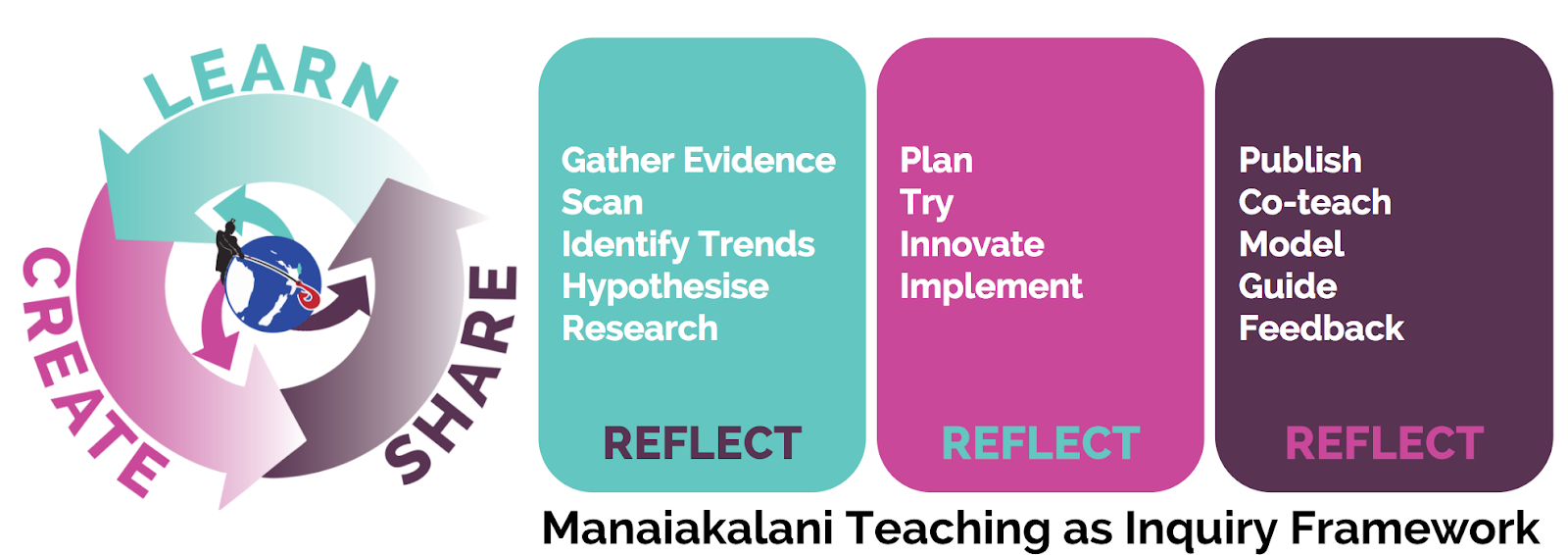
The teaching as inquiry framework I will continue to use in 2019 has been specifically co-constructed for Manaiakalani schools using our familiar Learn Create Share structure.

The elements in this framework share close similarities with other models New Zealand teachers use.


Throughout the year, I will be labelling my blog posts to reflect our Learn, Create, Share structure.


LEvidence
Learn - Gather Evidence
CPlan
Create - Make a plan
SPublish
Share - Publish
LScan
Learn - Scan
CTry
Create - Try new things
SCoteach
Share - Co-teach
LTrend
Learn - Identify Trends
CInnovate
Create - Innovate
SModel
Share - Model
LHypothesise
Learn - Hypothesise
CImplement
Create - Implement
SGuide
Share - Guide
LResearch
Learn - Research
CReflect
Create - Reflect
SFback
Share - Feedback
LReflect
Learn - Reflect


SReflect
Share - Reflect

Tuesday, 5 February 2019

My 2019 CoL Inquiry Focus:
“Promoting vocabulary acquisition to strengthen reading comprehension and stimulate student led dialogic conversations.”

The Manaiakalani Community of Learning is working together on this task using the expertise existing in of our community of learning.

In 2019 for my inquiry I have selected the following CoL achievement challenge: 
Increase the achievement in Years 7-10, in Reading, Writing, and Maths, as measured against National Standards and agreed targets.
The teaching as inquiry framework I will continue to use in 2019 has been specifically co-constructed for Manaiakalani schools using our familiar Learn Create Share structure.

The elements in this framework share close similarities with other models New Zealand teachers use.


Throughout the year, I will be labelling my blog posts to reflect our Learn, Create, Share structure.


LEvidence
Learn - Gather Evidence
CPlan
Create - Make a plan
SPublish
Share - Publish
LScan
Learn - Scan
CTry
Create - Try new things
SCoteach
Share - Co-teach
LTrend
Learn - Identify Trends
CInnovate
Create - Innovate
SModel
Share - Model
LHypothesise
Learn - Hypothesise
CImplement
Create - Implement
SGuide
Share - Guide
LResearch
Learn - Research
CReflect
Create - Reflect
SFback
Share - Feedback
LReflect
Learn - Reflect


SReflect
Share - Reflect

Wednesday, 29 August 2018

2018 Manaiakalani Annual Hui

As a CoL Teacher, I was asked to present a short 10 minute synopsis of my Inquiry to date at the Annual Manaiakalani Hui.   It was a great time to reflect on what I have done so far in my Inquiry and to begin to think about what I should try to do in the next few weeks before the end of the term.  I always enjoy sharing what I have been doing in my classroom with others, and it was a great opportunity to have professional conversations with others from across our cluster who are doing similar inquiries into their own teaching practice.

Although it was a bit daunting at first, it definitely was a great honour to have Dr. Jannie van Hees join the round table discussion about my Inquiry. 

To start each round of presentations, a short video was played introducing the CoL teachers that would be presenting.  Here is the video that I put together for my presentation and a few pictures from my round table presentation.


Thursday, 25 January 2018

2018 Manaiakalani Teaching As Inquiry Framework

My 2018 CoL Inquiry Focus:
“Using dialogic discussions to expand vocabulary usage while strengthening reading comprehension.”

The Manaiakalani Community of Learning is working together on this task using the expertise existing in of our community of learning.

In 2018 for my inquiry I have selected the following CoL achievement challenge: 
3. Lift the achievement in reading for all students, with a particular focus on boys and Māori students (both genders), years 1-13

The teaching as inquiry framework I will continue to use in 2018 has been specifically co-constructed for Manaiakalani schools using our familiar Learn Create Share structure.

The elements in this framework share close similarities with other models New Zealand teachers use.


Throughout the year, I will be labelling my blog posts to reflect our Learn, Create, Share structure.


LEvidence
Learn - Gather Evidence
CPlan
Create - Make a plan
SPublish
Share - Publish
LScan
Learn - Scan
CTry
Create - Try new things
SCoteach
Share - Co-teach
LTrend
Learn - Identify Trends
CInnovate
Create - Innovate
SModel
Share - Model
LHypothesise
Learn - Hypothesise
CImplement
Create - Implement
SGuide
Share - Guide
LResearch
Learn - Research
CReflect
Create - Reflect
SFback
Share - Feedback
LReflect
Learn - Reflect


SReflect
Share - Reflect

Tuesday, 21 November 2017

2017 Bursts and Bubbles

As an end of the year event, the Manaiakalani Community of Learning held a "Bursts and Bubbles."  Each CoL teacher was given 3 minutes to share their own Impact Burst with the audience.  When preparing for our 'Burst' we were asked to think about four main aspects of our Inquiry.

What happened for the learners?
What evidence do I have for this?
What did I do to make this happen?
Wonderings about what next?

Here is a short video clip of the event which highlights my Impact Burst.

Wednesday, 15 November 2017

Through the Eyes of a Child: A Success Story

This year, I have been inquiring into extending prior knowledge and critical thinking, while promoting dialogic conversations when working with Year 4 students who are reading At/Above their grade level.

One of the students in my class, ended the school year in 2016 with a reading age of 8 years.  This put her "at" the National Standard for Year 3, but it placed her in my middle group for term 1.  This was the group that was working with a very basic version of reading wider and deeper into our cluster wide Inquiry Te Taiao o Tamaki.


However, as the term progressed, it was evident that this beautiful girl was ready to take control of her learning and she was one of the very first to begin working on her assignments from a home computer at night and on the weekends.

As a class, we began reading a few times a week from chapter books, and sharing short summaries on our blogs.  I did not focus on the actual writing of the summary, but really just wanted to get them sharing and talking about what they were reading.  I believe having the freedom to share has helped her discover her own voice when sharing.


As term 2 rolled around, and our beginning of the year testing results came out, she showed tremendous growth, and began reading with the group that was my CoL focus group.  She immediately was able to jump right in and it only took a few weeks to get her to begin talking and sharing her ideas with the rest of the group. This is one area that she has grown tremendously in this year.  


Her progress has continued to be seen in class on a daily basis, and she has become one of the leaders in my focus group...even though she is not part of the actual "focus group of 7."

When looking at her testing data, it is quite interesting to note that she had the exact same Scale Score (33.8 +/- 4) at the beginning and the end of the year, and her STAR Scale Score only increased slightly (from 89.2 +/- 4.5 to 89.9 +/- 3.6).  However, her Running Record Reading Age has increased from 8 years at the end of 2016 to 10.5 years at the end of Term 3 2017.   

She has made 2.5 years accelerated shift in her reading age!

While I am celebrating this, I am also considering some key areas of growth that she will need to continue in as she progresses through to Year 5 next year.  

*Continuing to increase in her confidence when sharing what she has read with others.  
*Making connections across texts and looking deeper into a subject when more clarification is necessary (or personal intrigue prompts)
*Confidently sharing her opinion on a subject and backing it up with related information from within a text. 


Thursday, 26 October 2017

Presenting at the 2017 Manaiakalani Wananga

The annual Manaiakalani Wananga was held today at Pt. England School for all of the principals and school leaders from the schools across Manaiakalani and the Outreach Clusters. 

I was asked to present, along with a panel of teachers representing the Manaiakalani CoL, what we have been doing this year as we conduct our Collaborative CoL Inquiry into our own teaching practice.  Each of the presenters represented one of the Manaiakalani CoL Achievement Standards that our CoL teachers and Manaiakalani schools are Inquiring into.


Introducing myself to the Wananga participants. 
2017 Wananga
I am so thankful for the opportunity to share my Inquiry and I feel that every time I present, I feel less nervous and a little bit more confident sharing in front of a large group.  This year, I have discovered that this Inquiry process quickly makes something you considered out of reach a year ago your daily normal. You become so invested in the Inquiry process and what you see as successful that you forget that everyone else has not walked every step of the way with you. When given the opportunity to present, I thoroughly enjoy the verbal (and non-verbal) response you receive from those in attendance as you share your small steps, trials and triumphs, and of course it's always fun to receive one or two "Cheehoo's" in our Pasifika community.

Wednesday, 4 October 2017

Share-Term 4 2017

As part of my Community of Learning Inquiry and Spark-MIT Inquiry this past term, I have been focusing on the Learn portion of the Manaiakalani Inquiry Framework. The "Share Focus" answers the question:

“What has happened as a result of the changes in teaching, and what are the implications for future teaching?

 Below is a summary of the various Inquiry Items and links to specific blog posts that I have put together as evidence of each item.

Click here to open an interactive version of this document. 

Saturday, 9 September 2017

Presenting at the Manaiakalani Boards' Forum

This past Thursday night, I was one of six CoL teachers asked to present my Inquiry representing the six different Community of Learning Achievement Challenges.

It was a great night to simply be reminded of the BIG picture that we are a part of in many ways, not only as CoL teachers but as Manaiakalani classroom teachers.

As the night began, participants were given the opportunity to take a look at our poster presentations for the Manaiakalani Hui  Then, after hearing about all of the various Manaiakalani is supporting teachers, and student learning, across the nation, it was our turn to share each of the Achievement Challenges and what our individual focus has been for the 2017 school year.

Here are some pictures of the night (taken by +Fiona Grant) and the slide deck that I presented, which was comprised of a mixture of slides from presentations that I have made over the past few weeks.


Monday, 28 August 2017

2017 Manaiakalani Annual Hui-Kahui Ako

This past Friday, the Manaiakalani Cluster held it's annual Hui at the Panmure Yacht & Boating Club.  During the day, I had two different chances to share my Inquiry with my colleagues and those in attendance.

During the morning session, the Spark-MIT teachers gave our first Ignite Talk to those in attendance.  It was a great opportunity to share and present a short (6 minute) presentation about what I have been doing with my literacy students this year. I was able to realise a few things about what I had prepared in order to help better prepare myself for our upcoming session at the New Zealand ULearn conference in October.

My Presentation Board
Our CoL teachers were also able to share our inquiries in a "science fair style" poster presentation that enabled participants to move around and view what we have been doing.

Participants were given a bingo style card for us to sign when our booth was visited and interacted with.  Many participants took some time to leave extremely positive and helpful comments on our blogs. During this time, many stopped by my booth and talked about how they had been following my professional blog this year and using some of the things I've talked about in their own classrooms.

Perhaps the most rewarding conversation I was able to have was with Rebecca Jesson from the Woolf Fisher Research Centre, whose findings and suggestions I have based most of my implementations on.  It was so reassuring to hear what she had to say and to answer the questions that she had after hearing my speech in the earlier session of the day.

Speaking with Manaiakalani's Dave Winters at the Hui.