Showing posts with label SGuide. Show all posts

Monday, 3 February 2020

My 2020 CoL Inquiry Focus

My 2020 CoL Inquiry Focus:

“How can providing opportunities for mathematical vocabulary acquisition strengthen a student’s self-efficacy in maths?”

The Manaiakalani Community of Learning is working together on this task using the expertise existing in of our community of learning.

In 2020 for my inquiry I have selected the following CoL achievement challenge: 
Increase the achievement in Years 7-10, in Reading, Writing, and Maths, as measured against National Standards and agreed targets.
The teaching as inquiry framework I will continue to use in 2019 has been specifically co-constructed for Manaiakalani schools using our familiar Learn Create Share structure.

The elements in this framework share close similarities with other models New Zealand teachers use.
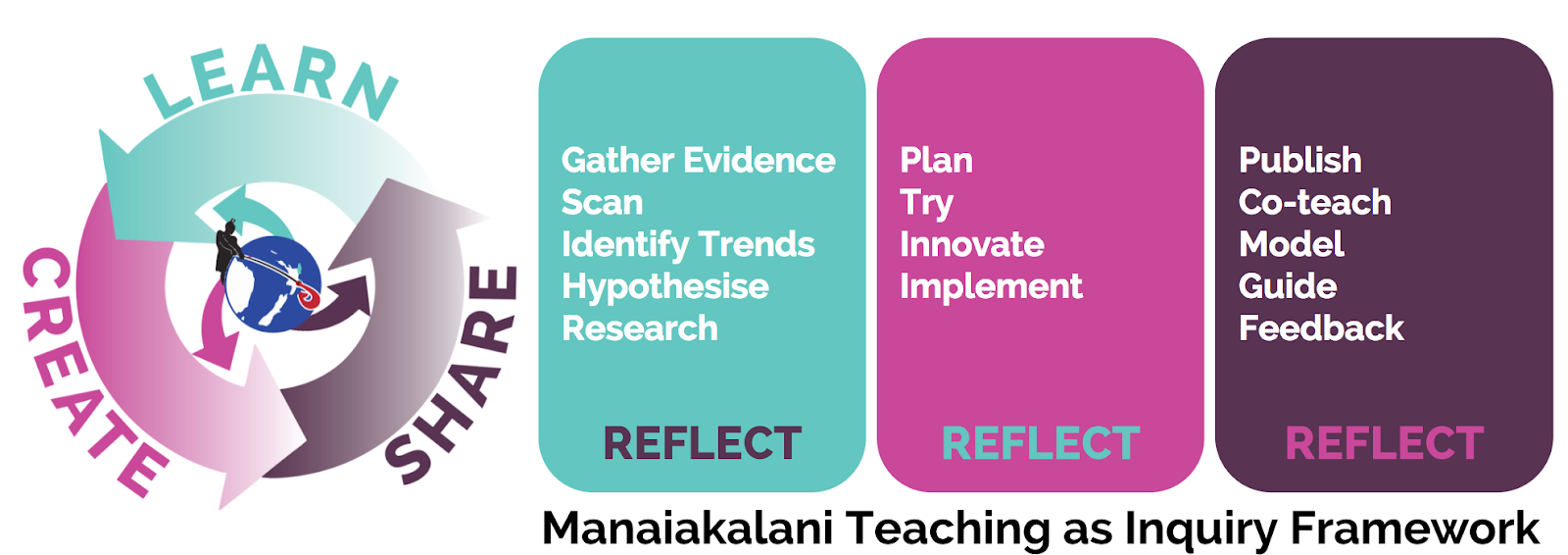

Throughout the year, I will be labelling my blog posts to reflect our Learn, Create, Share structure.


LEvidence
Learn - Gather Evidence
CPlan
Create - Make a plan
SPublish
Share - Publish
LScan
Learn - Scan
CTry
Create - Try new things
SCoteach
Share - Co-teach
LTrend
Learn - Identify Trends
CInnovate
Create - Innovate
SModel
Share - Model
LHypothesise
Learn - Hypothesise
CImplement
Create - Implement
SGuide
Share - Guide
LResearch
Learn - Research
CReflect
Create - Reflect
SFback
Share - Feedback
LReflect
Learn - Reflect


SReflect
Share - Reflect

Tuesday, 5 February 2019

My 2019 CoL Inquiry Focus:
“Promoting vocabulary acquisition to strengthen reading comprehension and stimulate student led dialogic conversations.”

The Manaiakalani Community of Learning is working together on this task using the expertise existing in of our community of learning.

In 2019 for my inquiry I have selected the following CoL achievement challenge: 
Increase the achievement in Years 7-10, in Reading, Writing, and Maths, as measured against National Standards and agreed targets.
The teaching as inquiry framework I will continue to use in 2019 has been specifically co-constructed for Manaiakalani schools using our familiar Learn Create Share structure.

The elements in this framework share close similarities with other models New Zealand teachers use.


Throughout the year, I will be labelling my blog posts to reflect our Learn, Create, Share structure.


LEvidence
Learn - Gather Evidence
CPlan
Create - Make a plan
SPublish
Share - Publish
LScan
Learn - Scan
CTry
Create - Try new things
SCoteach
Share - Co-teach
LTrend
Learn - Identify Trends
CInnovate
Create - Innovate
SModel
Share - Model
LHypothesise
Learn - Hypothesise
CImplement
Create - Implement
SGuide
Share - Guide
LResearch
Learn - Research
CReflect
Create - Reflect
SFback
Share - Feedback
LReflect
Learn - Reflect


SReflect
Share - Reflect

Wednesday, 14 November 2018

The Pathway to Success


This year I was presented with a very special group of year 5 students, who for many different reasons required a lot of strategic strategies and routines to be formulated, tried, put in place and often reformulated in order to optimise student engagement and begin working on my proposed inquiry into my teaching practice.

Recently, I read the Code and Standards put out by the Education Council and many of the things that I really had to focus on and incorporate into my teaching practice this year are easily summed up by the 4 te reo Māori words listed as the values: whakamana, manaakitanga, pono and whanaungatanga.

The idea of whakamana been one of my favourite aspects of my job especially when working with our learners who struggle the most for whatever reason and striving to find the necessary tool that would allow for that individual student to reach their highest potential. Incorporating key strategies introduced by Dr. Janni van Hees has really helped many of my students reach their highest potential in literacy this year.

I have always believed that by being aware of Manaakitanga, and increasing a student’s sense of well-being and confidence directly impacts their ability to learn. Taking interest in a student’s day-to-day life promotes a sense of self-worth and importance, and allows for me, as their teacher, to understand possible barriers that need to be overcome for a child to succeed.

Showing integrity by treating my students fairly and respectfully is something that I am proud to say that I have heard students both past and present say is one of their favourite things about being in my class. This allows them to know where they stand and that they have a voice. It is my strong belief that by formulating this type of relationship with my students is what ultimately allows accelerated learning to take place. The concept of Pono also lays the basis for whanaungatanga to occur. Once that relationship has been fostered, a sense of Whanaungatanga is felt and students realise that their class is a whanau within the village of Pt. England School, they feel free to participate in dialogic conversations, take risks in their learning groups when answering tough questions, and in every aspect of their school life they are always striving to do their best.

Without these 4 values strongly evident in my classroom, I would never have been able to conduct my inquiry into my teaching this year, and my students would not have benefitted as a result of it.

I am currently in the process of administering the last of my end of the year tests, and as soon as that data is all in I will be sharing it on my blog and comparing it to the data from the beginning of the year.

Thursday, 25 January 2018

2018 Manaiakalani Teaching As Inquiry Framework

My 2018 CoL Inquiry Focus:
“Using dialogic discussions to expand vocabulary usage while strengthening reading comprehension.”

The Manaiakalani Community of Learning is working together on this task using the expertise existing in of our community of learning.

In 2018 for my inquiry I have selected the following CoL achievement challenge: 
3. Lift the achievement in reading for all students, with a particular focus on boys and Māori students (both genders), years 1-13

The teaching as inquiry framework I will continue to use in 2018 has been specifically co-constructed for Manaiakalani schools using our familiar Learn Create Share structure.

The elements in this framework share close similarities with other models New Zealand teachers use.


Throughout the year, I will be labelling my blog posts to reflect our Learn, Create, Share structure.


LEvidence
Learn - Gather Evidence
CPlan
Create - Make a plan
SPublish
Share - Publish
LScan
Learn - Scan
CTry
Create - Try new things
SCoteach
Share - Co-teach
LTrend
Learn - Identify Trends
CInnovate
Create - Innovate
SModel
Share - Model
LHypothesise
Learn - Hypothesise
CImplement
Create - Implement
SGuide
Share - Guide
LResearch
Learn - Research
CReflect
Create - Reflect
SFback
Share - Feedback
LReflect
Learn - Reflect


SReflect
Share - Reflect