Showing posts with label SFback. Show all posts

Monday, 3 February 2020

My 2020 CoL Inquiry Focus

My 2020 CoL Inquiry Focus:

“How can providing opportunities for mathematical vocabulary acquisition strengthen a student’s self-efficacy in maths?”

The Manaiakalani Community of Learning is working together on this task using the expertise existing in of our community of learning.

In 2020 for my inquiry I have selected the following CoL achievement challenge: 
Increase the achievement in Years 7-10, in Reading, Writing, and Maths, as measured against National Standards and agreed targets.
The teaching as inquiry framework I will continue to use in 2019 has been specifically co-constructed for Manaiakalani schools using our familiar Learn Create Share structure.

The elements in this framework share close similarities with other models New Zealand teachers use.
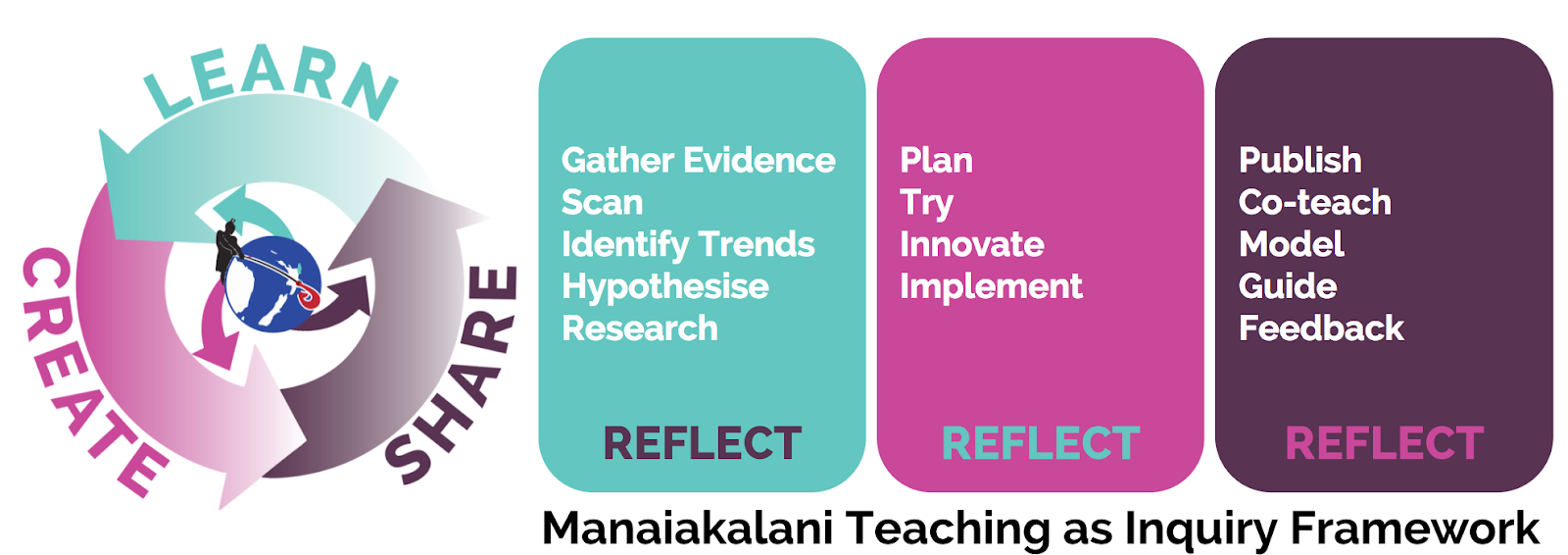

Throughout the year, I will be labelling my blog posts to reflect our Learn, Create, Share structure.


LEvidence
Learn - Gather Evidence
CPlan
Create - Make a plan
SPublish
Share - Publish
LScan
Learn - Scan
CTry
Create - Try new things
SCoteach
Share - Co-teach
LTrend
Learn - Identify Trends
CInnovate
Create - Innovate
SModel
Share - Model
LHypothesise
Learn - Hypothesise
CImplement
Create - Implement
SGuide
Share - Guide
LResearch
Learn - Research
CReflect
Create - Reflect
SFback
Share - Feedback
LReflect
Learn - Reflect


SReflect
Share - Reflect

Tuesday, 5 February 2019

My 2019 CoL Inquiry Focus:
“Promoting vocabulary acquisition to strengthen reading comprehension and stimulate student led dialogic conversations.”

The Manaiakalani Community of Learning is working together on this task using the expertise existing in of our community of learning.

In 2019 for my inquiry I have selected the following CoL achievement challenge: 
Increase the achievement in Years 7-10, in Reading, Writing, and Maths, as measured against National Standards and agreed targets.
The teaching as inquiry framework I will continue to use in 2019 has been specifically co-constructed for Manaiakalani schools using our familiar Learn Create Share structure.

The elements in this framework share close similarities with other models New Zealand teachers use.


Throughout the year, I will be labelling my blog posts to reflect our Learn, Create, Share structure.


LEvidence
Learn - Gather Evidence
CPlan
Create - Make a plan
SPublish
Share - Publish
LScan
Learn - Scan
CTry
Create - Try new things
SCoteach
Share - Co-teach
LTrend
Learn - Identify Trends
CInnovate
Create - Innovate
SModel
Share - Model
LHypothesise
Learn - Hypothesise
CImplement
Create - Implement
SGuide
Share - Guide
LResearch
Learn - Research
CReflect
Create - Reflect
SFback
Share - Feedback
LReflect
Learn - Reflect


SReflect
Share - Reflect

Thursday, 18 October 2018

Low Floor/High Ceiling in Literacy

As part of our DMIC professional development, we have been discussing a low floor (easy on ramp for our students who struggle)/high ceiling (a way to extend those who are ready to go further) concept when planning for our weekly maths tasks. It has been proposed that we should be doing something similar when working with our students in literacy as well.  After spending some time thinking about what this might look like in literacy, I have decided to try some things out this term.

For example, one of my reading groups was asked to read the text "Idea City" prior to meeting with me to read aloud and discuss.  Their independent assignment required them to gather some basic information from the text and then explore another website to select an artwork of their choice to describe and recreate. This allowed for students to independently explore NZ mural art as an immersion task during our first week of our Art focus term. It was my hope that students would make connections with the mural art around the country and the mural art in their own community.  


Going into week 2, students will continue to look at NZ wall Murals and those who are fast finishers will be asked to complete an Advice blog (format created by Matt Goodwin) as the 'High Ceiling" task.


As the term progresses, and into the 2019 school year, it is my goal to explore adequate low floor/high ceiling activities for my literacy students.

**Please note: This reading task was over the course of two weeks due to a already shortened week 2, which also included our end of the year writing assessment.

Monday, 3 September 2018

A Team Approach

During our Week 6 Staff Meeting, we spent some time looking at our reading data trends in our own classrooms and then discussed what we were seeing across the team.  It was definitely apparent (as I questioned in my previous blog post "Mid-Term 3 Shift Update") that we have a large number of students across our Year 5/6 team (of six teachers) that are instructionally reading between the ages of 8.5-9.5.

We broke up into groups of two (a year 5 and a year 6 teacher) to consider 5 main areas when planning for the students reading at that level.  I was paired with a year 6 teacher, Migi Sio, and this is what we came up with.


When we shared back with the remainder of our team, it was very surprising to hear that most of us chose a very similar WALT to focus on (simply worded differently).

A next step for me will be discussing this further with my teaching partner, Hannah West, to determine how we will be implementing this focus in our learning space.

Monday, 30 July 2018

The Casual Link...Accelerate: Conversation #3

During our beginning of Term 3 CoL meeting Dr. Rebecca Jesson challenged us once again by providing time for our team to engage in a number of conversations about the integrity of inquiry implementation. I felt that it was important to spend some more time reflecting on these guided questions in an effort to ensure that I am on the right path with my inquiry moving forward during this very important teaching term.


I believe the best place to refine my intervention is to provide more opportunities for students to see the vocabulary we are trying to build being recycled as often as possible. This happens by providing opportunities for discussions in literacy to build upon the vocabulary list when we read texts about the inquiry topic. This is done as best as I am able to with my students still on the Junior School end of the colour wheel.  However, with my students who are reading age 8 and above I am able to do this more in depth and with more consistency with the texts provided. I am also working to provide avenues for the vocabulary to be used by the students in the literacy create tasks and their writing tasks. By allowing students to hear, see and use the vocabulary we are focusing on in many ways will hopefully allow for the recycling of words to occur and become the new normal for my students. 

Integrity of Implementation Conversation #2

During our beginning of Term 3 CoL meeting Dr. Rebecca Jesson challenged us once again by providing time for our team to engage in a number of conversations about the integrity of inquiry implementation.  I felt that it was important to spend some more time reflecting on these guided questions in an effort to ensure that I am on the right path with my inquiry moving forward during this very important teaching term. 


The intended change in teaching was to integrate a more strategic approach to providing avenues for extended vocabulary development and usage. I have been trying to implement the new strategies that have been modelled at our COL PD sessions. My goal is to implement each strategy before we meet again and then find ways to recycle that strategy every 5 weeks or so.  However, timing is always a factor and change in scheduling as the school year becomes more and more busy. I have been trailing most of the activities with my own literacy groups and sometimes as a whole literacy class.  I have also used some strategies during our whole space (60 student) writing lessons.

I know I have been doing it differently because I try to capture digital evidence of my changes or student examples over time.  This information can be found in my various blog posts and whole inquiry reflections as the year draws to an end.

At times, there have been some intended changes that have worked out exactly as I had hoped, and other times I have had to modify things slightly to work with the students that I had in front on me for that timeframe.  However, for the most part, I have tried to do the language abundance activities as close to how they were modelled for us.

Integrity of Implementation Conversation #1

During our beginning of Term 3 CoL meeting Dr. Rebecca Jesson challenged us once again by providing time for our team to engage in a number of conversations about the integrity of inquiry implementation.  I felt that it was important to spend some more time reflecting on these guided questions in an effort to ensure that I am on the right path with my inquiry moving forward during this very important teaching term. 


We are very blessed the the majority of our research on Language Abundance is being provided for us during our Professional Development sessions with Dr. Jannie van Hees.  Jannie always models for us a number of proven activities to do with our students in an effort to introduce, recycle and maintain the rich level of vocabulary that we are hoping to move our students to using on a daily basis.

I have been trying my best to trail everything that Jannie has introduced to us and include my experience on my professional blog. However, I believe that I am finding it difficult to balance the time allotted for each activity as well as continuing with our general literacy program. I am hoping to spend some more time this term providing more opportunities for my students to experience Jannie's Language Abundance activities and becoming more confident with the delivery as well.

I have learnt that sometimes in order to make a difference you have to do things differently.  This can be a scary thing to do, especially after hearing our school (and CoL) beginning of term refocus talk, which discussed the importance of seeing all of our learning groups a minimum of two times per week in each subject area.  However, in order to deliver some of the language abundance activities some of those sessions would have to be combined group activities.

Thursday, 25 January 2018

2018 Manaiakalani Teaching As Inquiry Framework

My 2018 CoL Inquiry Focus:
“Using dialogic discussions to expand vocabulary usage while strengthening reading comprehension.”

The Manaiakalani Community of Learning is working together on this task using the expertise existing in of our community of learning.

In 2018 for my inquiry I have selected the following CoL achievement challenge: 
3. Lift the achievement in reading for all students, with a particular focus on boys and Māori students (both genders), years 1-13

The teaching as inquiry framework I will continue to use in 2018 has been specifically co-constructed for Manaiakalani schools using our familiar Learn Create Share structure.

The elements in this framework share close similarities with other models New Zealand teachers use.


Throughout the year, I will be labelling my blog posts to reflect our Learn, Create, Share structure.


LEvidence
Learn - Gather Evidence
CPlan
Create - Make a plan
SPublish
Share - Publish
LScan
Learn - Scan
CTry
Create - Try new things
SCoteach
Share - Co-teach
LTrend
Learn - Identify Trends
CInnovate
Create - Innovate
SModel
Share - Model
LHypothesise
Learn - Hypothesise
CImplement
Create - Implement
SGuide
Share - Guide
LResearch
Learn - Research
CReflect
Create - Reflect
SFback
Share - Feedback
LReflect
Learn - Reflect


SReflect
Share - Reflect

Wednesday, 4 October 2017

Share-Term 4 2017

As part of my Community of Learning Inquiry and Spark-MIT Inquiry this past term, I have been focusing on the Learn portion of the Manaiakalani Inquiry Framework. The "Share Focus" answers the question:

“What has happened as a result of the changes in teaching, and what are the implications for future teaching?

 Below is a summary of the various Inquiry Items and links to specific blog posts that I have put together as evidence of each item.

Click here to open an interactive version of this document. 

Tuesday, 7 February 2017

Manaiakalani Teaching as Inquiry Framework

My 2017 CoL Inquiry Focus:
“Extending prior knowledge and critical thinking, while promoting dialogic conversations with students who are reading at/above grade level.”

The Manaiakalani Community of Learning is working together on this task using the expertise existing in of our community of learning.

In 2017 for my inquiry I have selected the following CoL achievement challenge: 
3. Lift the achievement in reading for all students, with a particular focus on boys and Māori students (both genders), years 1-13

The teaching as inquiry framework I will be using in 2017 has been specifically co-constructed for Manaiakalani schools using our familiar Learn Create Share structure.

The elements in this framework share close similarities with other models New Zealand teachers use.


Throughout the year, I will be labelling my blog posts to reflect our Learn, Create, Share structure.


LEvidence
Learn - Gather Evidence
CPlan
Create - Make a plan
SPublish
Share - Publish
LScan
Learn - Scan
CTry
Create - Try new things
SCoteach
Share - Co-teach
LTrend
Learn - Identify Trends
CInnovate
Create - Innovate
SModel
Share - Model
LHypothesise
Learn - Hypothesise
CImplement
Create - Implement
SGuide
Share - Guide
LResearch
Learn - Research
CReflect
Create - Reflect
SFback
Share - Feedback
LReflect
Learn - Reflect


SReflect
Share - Reflect