Showing posts with label Dr. Rebecca Jesson. Show all posts

Monday, 30 July 2018

The Casual Link...Accelerate: Conversation #3

During our beginning of Term 3 CoL meeting Dr. Rebecca Jesson challenged us once again by providing time for our team to engage in a number of conversations about the integrity of inquiry implementation. I felt that it was important to spend some more time reflecting on these guided questions in an effort to ensure that I am on the right path with my inquiry moving forward during this very important teaching term.


I believe the best place to refine my intervention is to provide more opportunities for students to see the vocabulary we are trying to build being recycled as often as possible. This happens by providing opportunities for discussions in literacy to build upon the vocabulary list when we read texts about the inquiry topic. This is done as best as I am able to with my students still on the Junior School end of the colour wheel.  However, with my students who are reading age 8 and above I am able to do this more in depth and with more consistency with the texts provided. I am also working to provide avenues for the vocabulary to be used by the students in the literacy create tasks and their writing tasks. By allowing students to hear, see and use the vocabulary we are focusing on in many ways will hopefully allow for the recycling of words to occur and become the new normal for my students. 

Integrity of Implementation Conversation #2

During our beginning of Term 3 CoL meeting Dr. Rebecca Jesson challenged us once again by providing time for our team to engage in a number of conversations about the integrity of inquiry implementation.  I felt that it was important to spend some more time reflecting on these guided questions in an effort to ensure that I am on the right path with my inquiry moving forward during this very important teaching term. 


The intended change in teaching was to integrate a more strategic approach to providing avenues for extended vocabulary development and usage. I have been trying to implement the new strategies that have been modelled at our COL PD sessions. My goal is to implement each strategy before we meet again and then find ways to recycle that strategy every 5 weeks or so.  However, timing is always a factor and change in scheduling as the school year becomes more and more busy. I have been trailing most of the activities with my own literacy groups and sometimes as a whole literacy class.  I have also used some strategies during our whole space (60 student) writing lessons.

I know I have been doing it differently because I try to capture digital evidence of my changes or student examples over time.  This information can be found in my various blog posts and whole inquiry reflections as the year draws to an end.

At times, there have been some intended changes that have worked out exactly as I had hoped, and other times I have had to modify things slightly to work with the students that I had in front on me for that timeframe.  However, for the most part, I have tried to do the language abundance activities as close to how they were modelled for us.

Integrity of Implementation Conversation #1

During our beginning of Term 3 CoL meeting Dr. Rebecca Jesson challenged us once again by providing time for our team to engage in a number of conversations about the integrity of inquiry implementation.  I felt that it was important to spend some more time reflecting on these guided questions in an effort to ensure that I am on the right path with my inquiry moving forward during this very important teaching term. 


We are very blessed the the majority of our research on Language Abundance is being provided for us during our Professional Development sessions with Dr. Jannie van Hees.  Jannie always models for us a number of proven activities to do with our students in an effort to introduce, recycle and maintain the rich level of vocabulary that we are hoping to move our students to using on a daily basis.

I have been trying my best to trail everything that Jannie has introduced to us and include my experience on my professional blog. However, I believe that I am finding it difficult to balance the time allotted for each activity as well as continuing with our general literacy program. I am hoping to spend some more time this term providing more opportunities for my students to experience Jannie's Language Abundance activities and becoming more confident with the delivery as well.

I have learnt that sometimes in order to make a difference you have to do things differently.  This can be a scary thing to do, especially after hearing our school (and CoL) beginning of term refocus talk, which discussed the importance of seeing all of our learning groups a minimum of two times per week in each subject area.  However, in order to deliver some of the language abundance activities some of those sessions would have to be combined group activities.

Thursday, 26 July 2018

CoL PD: Rebecca Jessen

Dr. Rebecca Jessen
Planning and Predicting: THEORY is everything

Studying cognition is like studying dolphins but only being able to see them when they pop out of the water.  How do I adjust what I do for when the dolphins pop out?

Image result for dolphins
Image Source
We should have a strong theory for what language abundance should look like for student acceleration to take place.  Providing opportunities for students to have meaningful conversations using rich vocabulary. Remembering to recycle vocabulary throughout the school day. 

Now is the time to take what we found 'worked' last term and make it happen more often this term. We need to start taking our results (looking at the kids 'it' worked for) and think about what worked for them and how it worked differently.  Also, reflecting on what I did differently.  Bearing in mind, how different students engaged, and how I engaged with different students.

Revisiting our Theory...what causes the shift? How was I able to obtain shift in the students so far this term? Theory is not quite everything. The only way to know if it works for a certain student is to try it out. 

Analysing implementation data
Moving from:
-What I wanted to happen (planned)?
To:
-What actually happened (delivered)?
To: THIS TERM
-How can I make sure this happens even better every time?

Opportunities for Teacher Learning
1. Figure out the students' strengths and needs
2. Use the existing research base to plan something different that is likely to use strengths to meet the need
3. DO the different thing
4. Which engages the students in a different way of learning?
5. Which results in learning...for all? for some? WHY??? What explains anomalies?


Monday, 26 March 2018

My Inquiry Chain of Events: A Reflection

In response to Rebecca and Aaron's presentation last week, I have spent some time pondering the 'Chain of Events' for my own Teaching Inquiry.  It is so easy to focus on the day to day aspect of my Inquiry that I am often reminding myself of the bigger picture of using daily language acquisition to aid in development of dialogic conversations about a text or group of texts.

Why is important to articulate all the links in your theory?
If I provide multi-modal opportunities for vocabulary acquisition, students will be able to confidently participate in topic specific dialogic conversations. Improved vocabulary acquisition, will lead to better achievement in reading because students will be able to discuss ideas within a text or across a group of texts about a particular topic. 

What knowledge and knowledge-building activities are needed to develop a strong theory?
In order to develop a strong theory, I need to see my students confidently sharing information from the text that they have read using the subject focused vocabulary for that text/topic type.  Students will be able to support their opinions using details from the text that provide rich topic specific vocabulary. This will be knowledge-building for me as the teacher because I will be able to hear first hand from the students who fully understand a topic and I will be able to know where to gently push to provide avenues of deeper thinking and discovery.  Ultimately, this will allow for deeper understanding when reading wider and deeper as the students develop the necessary baseline for that type of reading programme.

What will my “near” measure need to tell you?

My 'near' measure will need to show that the students are correctly using rich topic specific vocabulary in all situations.  The easy answer here is to say that they will be using topic specific vocabulary in their easttle writing test at the end of the year, and I will see a shift in their vocabulary score.  However, I really want it to be able to tell me that my students are confidently using vocabulary in situations across the curriculum as well as outside of the classroom in their day-to-day lives.  How I will go about measuring this is still yet to be determined (on the formative side), but in addition to easstle, the Burt test, Star and Running Record comprehension tests will also be good indicators of growth.

Thursday, 15 March 2018

CoL PD: Theory of Action

Once again, our kahui ako was able to spend some time hearing from Dr. Rebecca Jessen
and Dr. Aaron Wilson from the Woolf Fisher Research Centre at Auckland University.
They began by asking us the following question:


What will it take to obtain knowledge that is transferable when looking at our Inquiries?


TARGET: What is my theory of action?  How will I know?


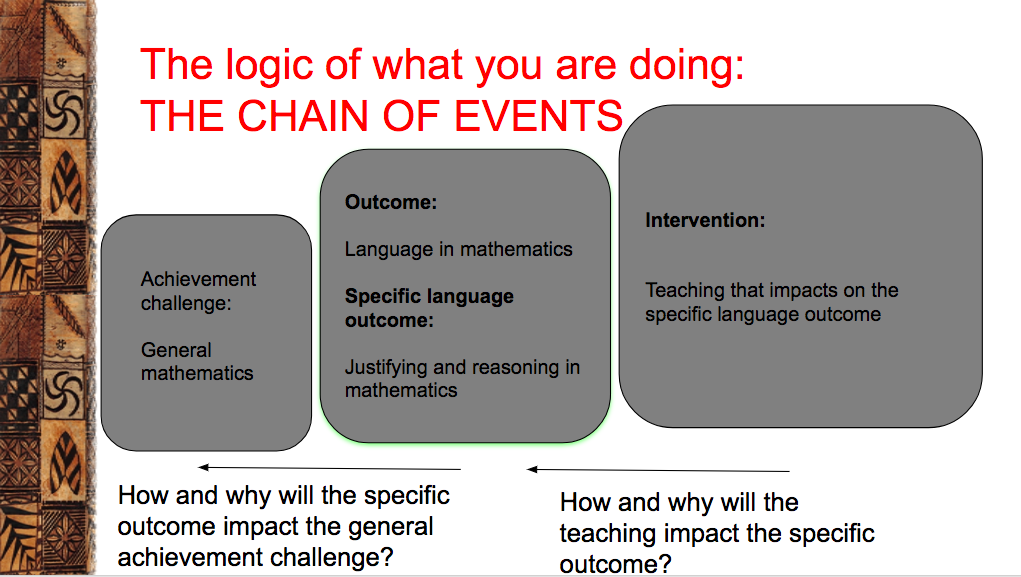
The logic of what we are doing:


THE CHAIN OF EVENTS


A causal chain is when a cause leads to an effect and that effect becomes the cause of another effect.


How and why will the specific outcome impact the general achievement challenge?


How and why will the teaching impact the specific outcome?


Source: Woolf Fisher Presentation

These next three questions to ponder we presented to us to consider when working through our own
teaching inquiry.  I will be spending some time working on my own answers at this time
over the next week or so.


-Why is important to articulate all the links in your theory?
Making it obvious for my own Inquiry!!


-What knowledge and knowledge-building activities are needed to develop a strong theory?
-What is it I want to see change for the kids will be knowledge-building for me as the

teacher.

Thursday, 8 February 2018

Rebecca Jesson: Meta Analysis of Inquiries

During our first Manaiakalani CoL meeting of the year we were blessed to hear from Dr. Rebecca Jesson once again from the Woolf Fisher Research Centre at Auckland University. This year, the research team is going to spend some time looking more closely at our Inquiries into our Teaching Practise as the year progresses and I am so excited to see what we are able to learn from each other in a combined effort to ensure accelerated progress for our students.

Meta Analysis of Inquiries

Rebecca Jesson
Woolf Fisher


“WFRC will analyse data and evidence from teachers’ inquiries to identified Learn Create Share practices likely to
contribute to accelerated progress for students.”


How can the power of inquiry be used to feed into the research of Woolf Fisher?  Meta Analysis will enable WF to
indicate elements of ‘what works.”


Knowledge building is part of our Inquiry process.


Meta Analysis is intended to:
  1. Address persistent learning challenges at scale
  2. Develop teacher knowledge based on teacher inquiry
  3. Transfer researched approaches into practice at scale


What is a Meta Analysis?
  1. Combined estimate of the effects of a particular approach (treatment)
  2. Assessment of whether the effects are statistically significant (likely to be more than no effect 95% of the time)
  3. Assessment of whether the effects are stable (does it vary a lot?)


What does this mean for us?

  1. Address learning challenge
  2. Building personal knowledge
  3. Identify clear research informed changes to practice likely to address the challenge
  4. Collect detailed evidence about changes to the teaching
  5. Collect detailed evidence about how students engaged with the changed teaching
  6. Gather data about effects on student learning

Thursday, 1 June 2017

Spark-MIT Innovation

As one of the MIT-Spark Innovative Teachers, I decided to have a go at creating a multimodal text database for the Manaiakalani and the Outreach clusters.  I have spent the past few months trying to formulate a plan for what this would/could look like, and what type(s) of information it would need to include.

This morning, I  was very fortunate to work with the Manaiakalani Outreach Facilitators to synthesize our collective understanding of the research provided by the Woolf Fisher Research Team, including Dr. Rebecca Jesson and Dr. Stuart McNaughton, from the University of Auckland.  We have been assured that if we provide our students with reading material that is both wide and deep, they will make accelerated progress.  To take it a step further, the modes of texts (journal, internet article, picture, graphic, video, song, etc) that we should be allowing our students to experience should vary as shown in the graphic provided by Dr. Jesson in a Professional Development session she did with the Pt England staff during the past year.


Time was then spent constructing a Google Spreadsheet system to be used as a collective database for teachers across our own cluster, and the outreach clusters to input information about their reading choices based on an original text/theme and supported by texts from each of the other text types in various modes.  

My Next Steps: During the upcoming weeks, I will be working to compile various examples multimodal texts to build the database.  I will also engage the participation of colleagues within my own school to help populate, use and offer feedback, while overseeing the database as it is populated by teachers across Manaiakalani and our Outreach clusters.

Tuesday, 24 January 2017

Things That Work-PD w/ R. Jesson

Today, as part of our back to school PD, our staff met with Dr. Rebecca Jesson from the Woolf Fisher Research Centre to discuss "Things that Work" according to our cluster and school wide data.

High Ticket Items for High Progress Teachers
  1. Critical Thinking
  2. Extending Reading/Writing (Mileage)
  3. Extended Discussion


How can we continue to raise the ceiling for our fluent students and still provide advanced learning for our kids who are struggling?


We Need to Continue:
  1. Focused reading instruction/guided reading
  2. Extra mileage from reading literature and reading to inquire (wide)
  3. Extra thinking through discussion about illustrations/inferences/perspectives/author’s craft (deep)
  4. Scaffolding for independence in reading


Risks of Scaffolding:
  1. Dependence:
    1. Teacher attention (noticing)
    2. Teacher correction (fixing)
  2. Narrowed opportunities for Learning
    1. Read aloud (so read less)
    2. Receive more item knowledge instruction (read for meaning less)
    3. Engage in tasks with less ‘holding power’ (read less) and off task more
    4. Given less to read (read less)
    5. Get interrupted more often, by more people, more quickly (read less)


Scaffolding both Wide and Deep:
  1. Choosing content for thinking
  2. Choosing texts for thinking
  3. Ensuring balanced diet of texts to build thinking over time
  4. Generating discussion for thinking


Critical Decision #1
Content choice-important, contestable, relevant
    1. Reading and writing about something
    2. Reading and writing to access the curriculum at level
Critical Decision #2
Text Choices
Critical Decision #3
Textual Diet:
Narrative dominates:
  • Controlled Vocabulary
  • Controlled Challenge
  • Tight Learning Focus
Critical Decision #4
How to generate student discussion:
  • We know children tend to guess what’s in your head
  • Often say as little as possible to let you know they know what’s in your head
  • Find ways to communicate that the purpose is to build on one another’s thinking

Monday, 5 December 2016

Accelerated Learning From Reading Wider and Deeper

As a result of our PD from Dr. Rebecca Jesson and the Wolfe Fisher Research Centre, the Team 4 teachers (of year 5/6 students) decided early on this year to refocus the way we approached our Reading Assignments. Students were given a 2-3 week mini-topics that supported our term long school topic focus. During those mini-topic inquiries, students explored an underlying topic in more depth through the use of multi-modal texts consisting of School Journal Articles, Online Articles, In Class Demonstrations and Online Videos. As a result of our strategic wider and deeper reading, our students have been able to confidently engage in dialogic conversations during their micro-teaching groups and with their peers across our ILE.

Originally, we decided to focus our wider/deeper reading to our students who were reading at age 9 and above. Due to the make up of my literacy class, this meant that I would be going wider/deeper with 10 of my students (rougly 1/3). However, as the term progressed, I started to use similar lessons, with many of the same reading assignments, with my students reading anywhere above age 7. It is important to note that the way my students were expected to read the texts varied based on their learning group and reading age. Generally my students reading above age 9 were expected to read the text silently to themselves during their micro-group lesson prior to opening the floor for a dialogic conversation to take place. When looking at my students reading from age 7 to 9, we would often take turns reading the text aloud in our micro-group. Other times, I would point students to one specific paragraph or section of the text that I thought was most important for us to spend some time looking at.

Students were more engaged, and conversations in my classroom increased greatly. Students were also more focused when working on their follow up and create tasks. That's great and all, but what does my data show?

My data for the end of the year is amazing! I am so proud of the achievement that my students have made, and I look forward to working to see how to make this work again next year.  I only had three students who did not increase their reading age this year. All of those students have been receiving services outside of the classroom and have made their own personal achievements to their learning during the school year not measured on a Running Record.