Showing posts with label Dr. Aaron Wilson. Show all posts

Friday, 26 July 2019

COL PD: Monitoring and Identifying Change to Practice

During our COL Meeting, we spent some time with Aaron and Hanna discussing where we are at this time in our Inquiry process. Below are the points to ponder from that discussion.

Aaron and Hanna (WFRC)
Monitoring and Identifying Changes to Practice

Restate your Theory of Action:
The valued learning outcomes I want to improve for my students in this inquiry are….
The changes I am making to my teaching to improve their outcomes are…
The reasons why I think these changes in my teaching will be effective to my learners are…

Implementation
By the end of you inquiry, you want to know what the changes are that have happened for the learners and what has been the reason for it? What has the teacher done that caused those changes?
-Pre/Post for student understanding ...also pre/post updates on what is being changed in the classroom by the teacher
-Implementation fidelity-How faithful are you as the teacher in making sure that the actual intervention is the planned intervention (how can I be sure that opportunities in the classroom are authentically occurring)

Monitoring
-As well as informal monitoring (lesson-by-lesson and minute-by-minute planning), it is useful for more formal checkpoints
-Reflection and Inquiry have two different purposes...Inquiry has evidence to back it up. Reflections are more about how did it go.
-More micro-formative assessments (ie mini-easstles for reading tests)
-Student voice is vital. Quick fire exit questions, or chats with some case study students.


Tuesday, 26 March 2019

COL PD: Valued Learning Outcomes

WFRC: Aaron Wilson
As part of our second CoL Meeting of the term, we had an opportunity to once again hear from Dr Aaron Wilson from the Wolf Fisher Research Centre.  Dr Wilson pointed out the importance of recognising patterns and identifying Valued Learning Outcomes. Below are my notes and take aways from the session. 
Recap of Session 1:


Don’t focus your inquiry on the low hanging fruit things...what are the stubborn issues in your classroom and what can we do about it?
Teaching as Inquiry should not be an individual thing. In order to effectively change the cluster, we need to be grouped together more often to discuss our challenges and successes to ultimately make change for everyone.

Point of thought: Are our inquiry groups too small? Should we be focusing on our whole class or a larger group of students within our class?


Pattern Recognition: we need to come together as educators to see the patterns in our successes and failures so we can ALL learn from them.

Identifying Valued Learning Outcomes (VLOs):
  • Achievement
  • Progress
  • Māori learning as Māori
  • Key competencies
  • Participation
  • Affective outcomes
We need to focus on obtaining an holistic picture of our students.

Reading VLO’s:
  • Able to read and comprehend unfamiliar, age appropriate, texts independently - PAT/asTTle
  • Develops in reading ability at an at least expected rate of progress - PAT/asTTle
  • Reads regularly in and out of school
  • Loves reading
  • Has strategies for selecting texts for particular purposes
  • Knows that some texts will require resilience and persistence to make meaning from
  • Has a toolbox of strategies that s/he can use deliberately
  • Can synthesise across multiple texts
  • Considers connections between oral, written and visual language
  • Can read critically and is hyper-aware of authors’ positioning of readers
  • Appreciates aesthetic properties of language and literature

When you value things that are not texted in standardised tests you need to look at things much differently.

Point to Ponder:
For the problems that we are looking at, in order to build a really rich picture of student LEARNING (achievement and progress) what is that we need to know and how will you measure it? How can we find out what children CAN do?

Tuesday, 26 February 2019

CoL PD: Researching as Inquiry


Aaron Wilson -WFRC

During our first CoL meeting of 2019, we heard from Dr. Wilson from the Woolf Fisher Research Centre. He spent time talking with us about Researching as an Inquiry and the attributes of an Inquiring Teacher. Some really good reminders as to why, we as NZ teachers Inquire into our teaching practice. 


Researching as InquiryWe need to spend more time “understanding” our students more in the beginning of Inquiry before we jump in and start “trialing” things with them. We need to be analytical about our students in the beginning of the inquiry cycle and our teaching before the intervention.


Why Inquire? Three views of effective teaching (Aitken 2007)
1. The “style” view
2. The “outcomes” approach
3. The “inquiry” approach

The first two views do not effectively allow teachers in NZ to inquire accordingly with the NZ Curriculum.

It is necessary to have your Inquiry directed at something that is a hard to solve problem. It needs to be something that requires lots of contextualised problem solving.


8 Attributes of Inquiring Teachers

Efficacy: knowing that, notwithstanding other factors that affect student learning such as prior learning or socio-economic status, teachers can make a difference.

High expectations for all. An inquiring teacher is not satisfied because some or even most students have achieved valuable learning outcomes. Rather, she will seek to change, improve or refine teaching until learning success can be achieved by all.

Curiosity. Inquiring teachers do not accept the status quo. They ask why things are the way they are and how they can be changed. They seek new knowledge from experts, from published research and anywhere else they can get it.

Clarity about the student learning that is desired and the indicators of such learning.

Noticing. Inquiring teachers notice patterns of student learning during their classroom interactions with students, when they assess student work and examine achievement data.

Collegiality. The stubborn and persistent problems that are worth inquiring into can seldom be solved by one person. Good inquiry requires teams, leadership support and challenge, external viewpoints, external expertise, moral support.

Criticality. Inquiring teachers look at their own practice critically and look critically at easy solutions offered by others

Resilience. Because inquiry should be directed at the most stubborn and persistent problems there will be disappointments - the key is to monitor and notice as soon as possible and to see “failure” as an opportunity for new learning.

Monday, 7 May 2018

CoL PD: Aaron Wilson Formative Assesessment


Aaron Wilson
Formative Assessment for our Inquiry


As part of our Week 1, Term 2 CoL Meeting we heard from Dr. Wilson from the Woolf Fisher Research Centre and he discussed with us how to formatively assess our own Teaching Inquiry. Below are the outcomes that he suggested we (as teachers) use to assess our inquiries at this time.

Outcomes for Today:

1. Restate your Inquiry Question and your theory of action/chain of events (keep your eyes on the prize!)
2. Describe how you will collect information about the implementation of your changed practices/intervention (so it is clear what you are doing effectively)
3. KEY POINT: Clearly show readers what you did differently so they can make a judgement on whether or not it is reasonable to think that changed learner outcomes are related to your teaching practices
-Be sure to use a repeated measure (same tool..over and over)
-Detailed description before, during and after the intervention
-Show exactly how the learning changed for the student
4. Identify informal and formal ways you are monitoring the effects of your changed practices/interventions on desired learner outcomes and explain the reflections and tweaks you are making along the way (so you don’t wait until the end of your inquiry cycle and find it didn’t works)
5. Be sure to plan some formal checkpoints
-Checkpoints provide a systematic way that shows how students are experiencing the intervention and whether or not the impact you are trying to achieve is occuring
-Use micro-formative assessments at set intervals (ARBS, mini asTTle reading tests, etc).
-Student voice is vital! Be sure to collect this regularly in a manageable way. Ex: Quick fire “exit” questions
6. Describe how you will keep a record of each of the above in a manageable way (cuz you won’t otherwise remember all your many micro-decisions and why you made them)

Monday, 26 March 2018

My Inquiry Chain of Events: A Reflection

In response to Rebecca and Aaron's presentation last week, I have spent some time pondering the 'Chain of Events' for my own Teaching Inquiry.  It is so easy to focus on the day to day aspect of my Inquiry that I am often reminding myself of the bigger picture of using daily language acquisition to aid in development of dialogic conversations about a text or group of texts.

Why is important to articulate all the links in your theory?
If I provide multi-modal opportunities for vocabulary acquisition, students will be able to confidently participate in topic specific dialogic conversations. Improved vocabulary acquisition, will lead to better achievement in reading because students will be able to discuss ideas within a text or across a group of texts about a particular topic. 

What knowledge and knowledge-building activities are needed to develop a strong theory?
In order to develop a strong theory, I need to see my students confidently sharing information from the text that they have read using the subject focused vocabulary for that text/topic type.  Students will be able to support their opinions using details from the text that provide rich topic specific vocabulary. This will be knowledge-building for me as the teacher because I will be able to hear first hand from the students who fully understand a topic and I will be able to know where to gently push to provide avenues of deeper thinking and discovery.  Ultimately, this will allow for deeper understanding when reading wider and deeper as the students develop the necessary baseline for that type of reading programme.

What will my “near” measure need to tell you?

My 'near' measure will need to show that the students are correctly using rich topic specific vocabulary in all situations.  The easy answer here is to say that they will be using topic specific vocabulary in their easttle writing test at the end of the year, and I will see a shift in their vocabulary score.  However, I really want it to be able to tell me that my students are confidently using vocabulary in situations across the curriculum as well as outside of the classroom in their day-to-day lives.  How I will go about measuring this is still yet to be determined (on the formative side), but in addition to easstle, the Burt test, Star and Running Record comprehension tests will also be good indicators of growth.

Thursday, 15 March 2018

CoL PD: Theory of Action

Once again, our kahui ako was able to spend some time hearing from Dr. Rebecca Jessen
and Dr. Aaron Wilson from the Woolf Fisher Research Centre at Auckland University.
They began by asking us the following question:


What will it take to obtain knowledge that is transferable when looking at our Inquiries?


TARGET: What is my theory of action?  How will I know?


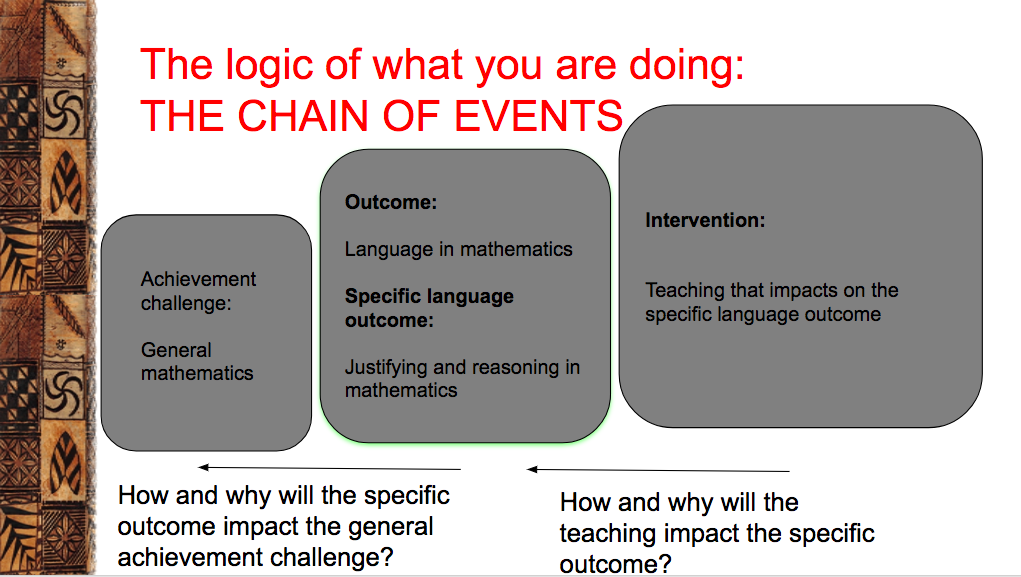
The logic of what we are doing:


THE CHAIN OF EVENTS


A causal chain is when a cause leads to an effect and that effect becomes the cause of another effect.


How and why will the specific outcome impact the general achievement challenge?


How and why will the teaching impact the specific outcome?


Source: Woolf Fisher Presentation

These next three questions to ponder we presented to us to consider when working through our own
teaching inquiry.  I will be spending some time working on my own answers at this time
over the next week or so.


-Why is important to articulate all the links in your theory?
Making it obvious for my own Inquiry!!


-What knowledge and knowledge-building activities are needed to develop a strong theory?
-What is it I want to see change for the kids will be knowledge-building for me as the

teacher.