Showing posts with label SModel. Show all posts

Monday, 3 February 2020

My 2020 CoL Inquiry Focus

My 2020 CoL Inquiry Focus:

How can providing opportunities for mathematical vocabulary acquisition strengthen a student’s self-efficacy in maths?

The Manaiakalani Community of Learning is working together on this task using the expertise existing in of our community of learning.

In 2020 for my inquiry I have selected the following CoL achievement challenge: 
Increase the achievement in Years 7-10, in Reading, Writing, and Maths, as measured against National Standards and agreed targets.
The teaching as inquiry framework I will continue to use in 2019 has been specifically co-constructed for Manaiakalani schools using our familiar Learn Create Share structure.

The elements in this framework share close similarities with other models New Zealand teachers use.
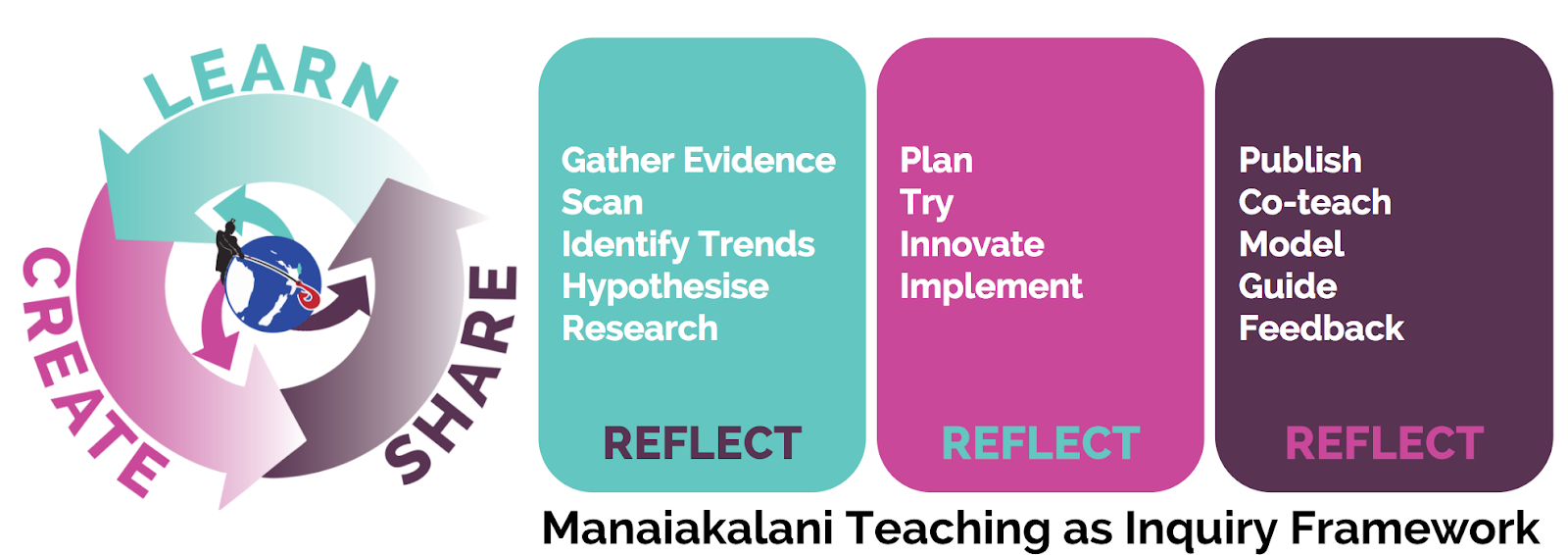

Throughout the year, I will be labelling my blog posts to reflect our Learn, Create, Share structure.


LEvidence
Learn - Gather Evidence
CPlan
Create - Make a plan
SPublish
Share - Publish
LScan
Learn - Scan
CTry
Create - Try new things
SCoteach
Share - Co-teach
LTrend
Learn - Identify Trends
CInnovate
Create - Innovate
SModel
Share - Model
LHypothesise
Learn - Hypothesise
CImplement
Create - Implement
SGuide
Share - Guide
LResearch
Learn - Research
CReflect
Create - Reflect
SFback
Share - Feedback
LReflect
Learn - Reflect


SReflect
Share - Reflect

Tuesday, 5 February 2019

My 2019 CoL Inquiry Focus:
“Promoting vocabulary acquisition to strengthen reading comprehension and stimulate student led dialogic conversations.”

The Manaiakalani Community of Learning is working together on this task using the expertise existing in of our community of learning.

In 2019 for my inquiry I have selected the following CoL achievement challenge: 
Increase the achievement in Years 7-10, in Reading, Writing, and Maths, as measured against National Standards and agreed targets.
The teaching as inquiry framework I will continue to use in 2019 has been specifically co-constructed for Manaiakalani schools using our familiar Learn Create Share structure.

The elements in this framework share close similarities with other models New Zealand teachers use.


Throughout the year, I will be labelling my blog posts to reflect our Learn, Create, Share structure.


LEvidence
Learn - Gather Evidence
CPlan
Create - Make a plan
SPublish
Share - Publish
LScan
Learn - Scan
CTry
Create - Try new things
SCoteach
Share - Co-teach
LTrend
Learn - Identify Trends
CInnovate
Create - Innovate
SModel
Share - Model
LHypothesise
Learn - Hypothesise
CImplement
Create - Implement
SGuide
Share - Guide
LResearch
Learn - Research
CReflect
Create - Reflect
SFback
Share - Feedback
LReflect
Learn - Reflect


SReflect
Share - Reflect

Wednesday, 14 November 2018

The Pathway to Success


This year I was presented with a very special group of year 5 students, who for many different reasons required a lot of strategic strategies and routines to be formulated, tried, put in place and often reformulated in order to optimise student engagement and begin working on my proposed inquiry into my teaching practice.

Recently, I read the Code and Standards put out by the Education Council and many of the things that I really had to focus on and incorporate into my teaching practice this year are easily summed up by the 4 te reo Māori words listed as the values: whakamana, manaakitanga, pono and whanaungatanga.

The idea of whakamana been one of my favourite aspects of my job especially when working with our learners who struggle the most for whatever reason and striving to find the necessary tool that would allow for that individual student to reach their highest potential. Incorporating key strategies introduced by Dr. Janni van Hees has really helped many of my students reach their highest potential in literacy this year.

I have always believed that by being aware of Manaakitanga, and increasing a student’s sense of well-being and confidence directly impacts their ability to learn. Taking interest in a student’s day-to-day life promotes a sense of self-worth and importance, and allows for me, as their teacher, to understand possible barriers that need to be overcome for a child to succeed.

Showing integrity by treating my students fairly and respectfully is something that I am proud to say that I have heard students both past and present say is one of their favourite things about being in my class. This allows them to know where they stand and that they have a voice. It is my strong belief that by formulating this type of relationship with my students is what ultimately allows accelerated learning to take place. The concept of Pono also lays the basis for whanaungatanga to occur. Once that relationship has been fostered, a sense of Whanaungatanga is felt and students realise that their class is a whanau within the village of Pt. England School, they feel free to participate in dialogic conversations, take risks in their learning groups when answering tough questions, and in every aspect of their school life they are always striving to do their best.

Without these 4 values strongly evident in my classroom, I would never have been able to conduct my inquiry into my teaching this year, and my students would not have benefitted as a result of it.

I am currently in the process of administering the last of my end of the year tests, and as soon as that data is all in I will be sharing it on my blog and comparing it to the data from the beginning of the year.

Wednesday, 29 August 2018

2018 Manaiakalani Annual Hui

As a CoL Teacher, I was asked to present a short 10 minute synopsis of my Inquiry to date at the Annual Manaiakalani Hui.   It was a great time to reflect on what I have done so far in my Inquiry and to begin to think about what I should try to do in the next few weeks before the end of the term.  I always enjoy sharing what I have been doing in my classroom with others, and it was a great opportunity to have professional conversations with others from across our cluster who are doing similar inquiries into their own teaching practice.

Although it was a bit daunting at first, it definitely was a great honour to have Dr. Jannie van Hees join the round table discussion about my Inquiry. 

To start each round of presentations, a short video was played introducing the CoL teachers that would be presenting.  Here is the video that I put together for my presentation and a few pictures from my round table presentation.


Thursday, 25 January 2018

2018 Manaiakalani Teaching As Inquiry Framework

My 2018 CoL Inquiry Focus:
“Using dialogic discussions to expand vocabulary usage while strengthening reading comprehension.”

The Manaiakalani Community of Learning is working together on this task using the expertise existing in of our community of learning.

In 2018 for my inquiry I have selected the following CoL achievement challenge: 
3. Lift the achievement in reading for all students, with a particular focus on boys and Māori students (both genders), years 1-13

The teaching as inquiry framework I will continue to use in 2018 has been specifically co-constructed for Manaiakalani schools using our familiar Learn Create Share structure.

The elements in this framework share close similarities with other models New Zealand teachers use.


Throughout the year, I will be labelling my blog posts to reflect our Learn, Create, Share structure.


LEvidence
Learn - Gather Evidence
CPlan
Create - Make a plan
SPublish
Share - Publish
LScan
Learn - Scan
CTry
Create - Try new things
SCoteach
Share - Co-teach
LTrend
Learn - Identify Trends
CInnovate
Create - Innovate
SModel
Share - Model
LHypothesise
Learn - Hypothesise
CImplement
Create - Implement
SGuide
Share - Guide
LResearch
Learn - Research
CReflect
Create - Reflect
SFback
Share - Feedback
LReflect
Learn - Reflect


SReflect
Share - Reflect

Thursday, 26 October 2017

Presenting at the 2017 Manaiakalani Wananga

The annual Manaiakalani Wananga was held today at Pt. England School for all of the principals and school leaders from the schools across Manaiakalani and the Outreach Clusters

I was asked to present, along with a panel of teachers representing the Manaiakalani CoL, what we have been doing this year as we conduct our Collaborative CoL Inquiry into our own teaching practice.  Each of the presenters represented one of the Manaiakalani CoL Achievement Standards that our CoL teachers and Manaiakalani schools are Inquiring into.


Introducing myself to the Wananga participants. 
2017 Wananga
I am so thankful for the opportunity to share my Inquiry and I feel that every time I present, I feel less nervous and a little bit more confident sharing in front of a large group.  This year, I have discovered that this Inquiry process quickly makes something you considered out of reach a year ago your daily normal. You become so invested in the Inquiry process and what you see as successful that you forget that everyone else has not walked every step of the way with you. When given the opportunity to present, I thoroughly enjoy the verbal (and non-verbal) response you receive from those in attendance as you share your small steps, trials and triumphs, and of course it's always fun to receive one or two "Cheehoo's" in our Pasifika community.

Tuesday, 24 October 2017

Multimodal Texts: Where to Start?

The one question I have been asked by a number of people, both at my own school and after presenting my Inquiry at various locations, is: How do you find your texts?

The simplest answer is that I begin with our school-wide Inquiry Topic focus for the upcoming term.  For example, when looking at Technology our team decided to incorporate Matariki and look at some of the ways Māori used technology with a primary focus on finding the best way to make a kite.

So, to start off I began searching through Journal Surf to see if I was able to find School Journal articles that related to our topic.  From there I decided that I needed to break the term up into a few smaller related topics.  As a class, my reading groups spent the first four weeks of the term reading and discussing Māori mythology.  We then moved into three weeks of technology with a specific focus on stories that introduced Māori kites in various forms, and we ended the term learning about Matariki.

As seen on the Google Slideshow below (taken from my class site), we started out reading our primary text which was from a School Journal article, "Making Manu Taratahi."   We then read another School Journal story "Eggshell" that was a complementary text because it provides more information about our primary topic the usage and construction of Māori kites.  


Now, as seen above in the yellow box, my selection of scaffolded texts (that provide students with more understanding of a topic to extend their prior knowledge while providing more detailed vocabulary) are generally taken from online resources.  As a result of our school Inquiry topics this year I have actually used the pages Te Ara often this year. It is an easy site for our students to navigate and often provides a multimodal resources on a topic. 

The last text type (in the green box) is supposed to be a Challenging text.  This text type can provide a different point-of-view or offer a difficulty in reading material.  This year, I am working with Year 4 students so I have often selected a text at a higher reading level (year 7/8) that fits with our topic.  This allows our group to have a more straight forward "reading" session where we are able to break up more difficult words and unpack their meaning for vocabulary expansion and understanding.  I have actually found that my student enjoy reading this text selection the most because after gaining an understanding of the topic they enjoy the challenge of reading something a little more difficult for fluency. 

The only text type not shown on this slide is student selected texts.  I have discussed using this text type in a previous blog post "Empowering Student Selected Texts". 

Wednesday, 4 October 2017

Share-Term 4 2017

As part of my Community of Learning Inquiry and Spark-MIT Inquiry this past term, I have been focusing on the Learn portion of the Manaiakalani Inquiry Framework. The "Share Focus" answers the question:

“What has happened as a result of the changes in teaching, and what are the implications for future teaching?

 Below is a summary of the various Inquiry Items and links to specific blog posts that I have put together as evidence of each item.

Click here to open an interactive version of this document. 

Saturday, 9 September 2017

Presenting at the Manaiakalani Boards' Forum

This past Thursday night, I was one of six CoL teachers asked to present my Inquiry representing the six different Community of Learning Achievement Challenges.

It was a great night to simply be reminded of the BIG picture that we are a part of in many ways, not only as CoL teachers but as Manaiakalani classroom teachers.

As the night began, participants were given the opportunity to take a look at our poster presentations for the Manaiakalani Hui  Then, after hearing about all of the various Manaiakalani is supporting teachers, and student learning, across the nation, it was our turn to share each of the Achievement Challenges and what our individual focus has been for the 2017 school year.

Here are some pictures of the night (taken by +Fiona Grant) and the slide deck that I presented, which was comprised of a mixture of slides from presentations that I have made over the past few weeks.


Monday, 28 August 2017

2017 Manaiakalani Annual Hui-Kahui Ako

This past Friday, the Manaiakalani Cluster held it's annual Hui at the Panmure Yacht & Boating Club.  During the day, I had two different chances to share my Inquiry with my colleagues and those in attendance.

During the morning session, the Spark-MIT teachers gave our first Ignite Talk to those in attendance.  It was a great opportunity to share and present a short (6 minute) presentation about what I have been doing with my literacy students this year. I was able to realise a few things about what I had prepared in order to help better prepare myself for our upcoming session at the New Zealand ULearn conference in October.

My Presentation Board
Our CoL teachers were also able to share our inquiries in a "science fair style" poster presentation that enabled participants to move around and view what we have been doing.

Participants were given a bingo style card for us to sign when our booth was visited and interacted with.  Many participants took some time to leave extremely positive and helpful comments on our blogs. During this time, many stopped by my booth and talked about how they had been following my professional blog this year and using some of the things I've talked about in their own classrooms.

Perhaps the most rewarding conversation I was able to have was with Rebecca Jesson from the Woolf Fisher Research Centre, whose findings and suggestions I have based most of my implementations on.  It was so reassuring to hear what she had to say and to answer the questions that she had after hearing my speech in the earlier session of the day.

Speaking with Manaiakalani's Dave Winters at the Hui.

Thursday, 17 August 2017

Pt. England COL Inquiry Presentation

This week, the PES COL teachers were asked to do a five minute presentation for the rest of our staff sharing how our Inquiries are going up to this point.  I found it so beneficial taking the time to go through where I am in my Inquiry now and the path that I have taken to come to this point with my class and in particular my focus group.

As I prepare my presentation for our upcoming Manaiakalani Hui next week, I am so thankful that I was able to share a portion of what will become part of that presentation ahead of time.  I compiled a video with a voice over recording of the presentation that I gave to include on my blog primarily for those who have asked to have a copy of certain parts for their own reference or further inquiry, but also as a great reminder of where I am at to this point.


Monday, 12 June 2017

The Multi-Text Database is Underway!


The main page of the database with detailed instructions showing what each submission should include.
I had an opportunity to share the work that has been done on the Manaiakalani Multi-Text Database with the Pt. England staff during our weekly staff meeting.  Although it was a quick presentation, it was well received and I am so excited to see the database being populated by Pt. England teachers in the weeks and months to come!

 I have also enjoyed seeing the database being shared in our Google+ Communities and populated by teachers across the country from our Manaiakalani Outreach Clusters.  I am spending time every day looking over what has been submitted, and it is really fun to see all the amazing work we are all doing in response to the findings of the Wolfe Fisher Research from the past few years.

If you are a Manaiakalani or Outreach teacher and you would like to have access to this database, we would love your input! Please send me an email or comment below.

Tuesday, 7 February 2017

Manaiakalani Teaching as Inquiry Framework

My 2017 CoL Inquiry Focus:
“Extending prior knowledge and critical thinking, while promoting dialogic conversations with students who are reading at/above grade level.”

The Manaiakalani Community of Learning is working together on this task using the expertise existing in of our community of learning.

In 2017 for my inquiry I have selected the following CoL achievement challenge: 
3. Lift the achievement in reading for all students, with a particular focus on boys and Māori students (both genders), years 1-13

The teaching as inquiry framework I will be using in 2017 has been specifically co-constructed for Manaiakalani schools using our familiar Learn Create Share structure.

The elements in this framework share close similarities with other models New Zealand teachers use.


Throughout the year, I will be labelling my blog posts to reflect our Learn, Create, Share structure.


LEvidence
Learn - Gather Evidence
CPlan
Create - Make a plan
SPublish
Share - Publish
LScan
Learn - Scan
CTry
Create - Try new things
SCoteach
Share - Co-teach
LTrend
Learn - Identify Trends
CInnovate
Create - Innovate
SModel
Share - Model
LHypothesise
Learn - Hypothesise
CImplement
Create - Implement
SGuide
Share - Guide
LResearch
Learn - Research
CReflect
Create - Reflect
SFback
Share - Feedback
LReflect
Learn - Reflect


SReflect
Share - Reflect