Wednesday, 25 January 2017

2017 PD: Connecting With Manaiakalani

This year I will be working as a CoL Teacher within my school, and as a part of this role I spent today at Day 1 of the Manaiakalani Cluster Orientation.  It was a great day collaborating with staff from across the cluster, including those who are knew to our cluster this year.  We spent the day hearing from Dorothy Burt about Who, What, How, and Where of Manaiakalani.


It was so amazing to be reminded about the backbone of what drives Manaiakalani to do the amazing things we are blessed to do to serve our community and the learners within it.  My favourite part of the day was the simple reminder that Manaiakalani is about the people...not the computers.  It is about making a difference in the lives of our students and their whanau by enabling them to become 'confident, connected, life-long learners'.


Tuesday, 24 January 2017

Things That Work-PD w/ R. Jesson

Today, as part of our back to school PD, our staff met with Dr. Rebecca Jesson from the Woolf Fisher Research Centre to discuss "Things that Work" according to our cluster and school wide data.

High Ticket Items for High Progress Teachers
  1. Critical Thinking
  2. Extending Reading/Writing (Mileage)
  3. Extended Discussion


How can we continue to raise the ceiling for our fluent students and still provide advanced learning for our kids who are struggling?


We Need to Continue:
  1. Focused reading instruction/guided reading
  2. Extra mileage from reading literature and reading to inquire (wide)
  3. Extra thinking through discussion about illustrations/inferences/perspectives/author’s craft (deep)
  4. Scaffolding for independence in reading


Risks of Scaffolding:
  1. Dependence:
    1. Teacher attention (noticing)
    2. Teacher correction (fixing)
  2. Narrowed opportunities for Learning
    1. Read aloud (so read less)
    2. Receive more item knowledge instruction (read for meaning less)
    3. Engage in tasks with less ‘holding power’ (read less) and off task more
    4. Given less to read (read less)
    5. Get interrupted more often, by more people, more quickly (read less)


Scaffolding both Wide and Deep:
  1. Choosing content for thinking
  2. Choosing texts for thinking
  3. Ensuring balanced diet of texts to build thinking over time
  4. Generating discussion for thinking


Critical Decision #1
Content choice-important, contestable, relevant
    1. Reading and writing about something
    2. Reading and writing to access the curriculum at level
Critical Decision #2
Text Choices
Critical Decision #3
Textual Diet:
Narrative dominates:
  • Controlled Vocabulary
  • Controlled Challenge
  • Tight Learning Focus
Critical Decision #4
How to generate student discussion:
  • We know children tend to guess what’s in your head
  • Often say as little as possible to let you know they know what’s in your head
  • Find ways to communicate that the purpose is to build on one another’s thinking

Thursday, 15 December 2016

Visible Learning in a Year 5/6 Classroom

Teaching in a Manaiakalani classroom means that my students have their learning visible online (via Google Sites). This means that a visible learning process leads to my students sharing their evidence of learning on their student blogs. Below is a screencast demonstrating a visible learning pathway for my student's this year.  


Monday, 5 December 2016

Accelerated Learning From Reading Wider and Deeper

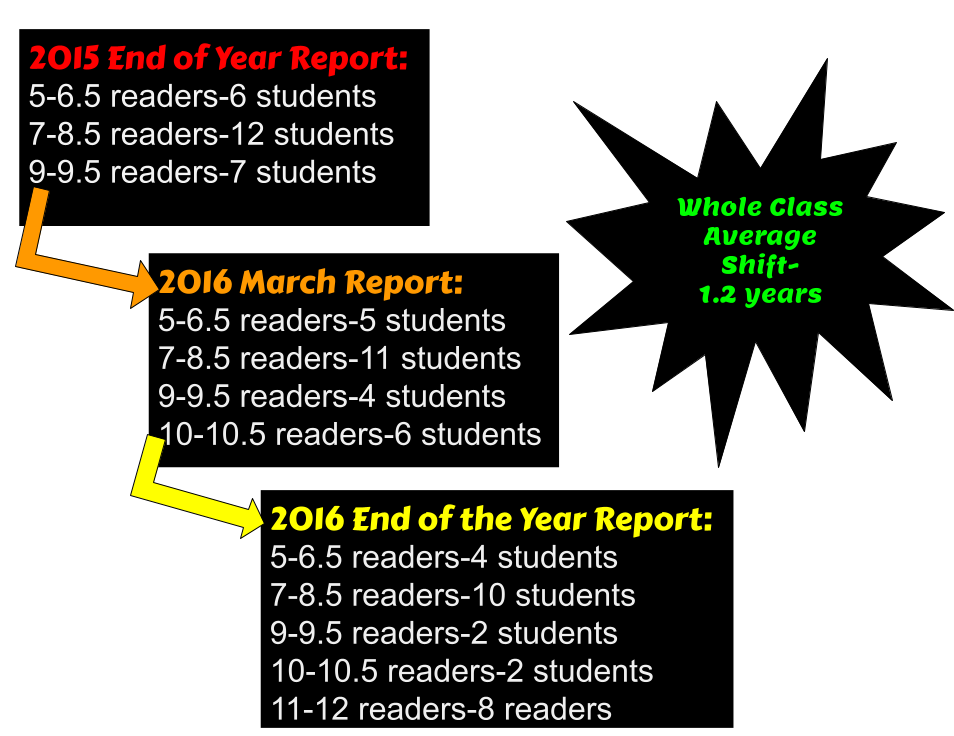
As a result of our PD from Dr. Rebecca Jesson and the Wolfe Fisher Research Centre, the Team 4 teachers (of year 5/6 students) decided early on this year to refocus the way we approached our Reading Assignments. Students were given a 2-3 week mini-topics that supported our term long school topic focus. During those mini-topic inquiries, students explored an underlying topic in more depth through the use of multi-modal texts consisting of School Journal Articles, Online Articles, In Class Demonstrations and Online Videos. As a result of our strategic wider and deeper reading, our students have been able to confidently engage in dialogic conversations during their micro-teaching groups and with their peers across our ILE.

Originally, we decided to focus our wider/deeper reading to our students who were reading at age 9 and above. Due to the make up of my literacy class, this meant that I would be going wider/deeper with 10 of my students (rougly 1/3). However, as the term progressed, I started to use similar lessons, with many of the same reading assignments, with my students reading anywhere above age 7. It is important to note that the way my students were expected to read the texts varied based on their learning group and reading age. Generally my students reading above age 9 were expected to read the text silently to themselves during their micro-group lesson prior to opening the floor for a dialogic conversation to take place. When looking at my students reading from age 7 to 9, we would often take turns reading the text aloud in our micro-group. Other times, I would point students to one specific paragraph or section of the text that I thought was most important for us to spend some time looking at.

Students were more engaged, and conversations in my classroom increased greatly. Students were also more focused when working on their follow up and create tasks. That's great and all, but what does my data show?

My data for the end of the year is amazing! I am so proud of the achievement that my students have made, and I look forward to working to see how to make this work again next year.  I only had three students who did not increase their reading age this year. All of those students have been receiving services outside of the classroom and have made their own personal achievements to their learning during the school year not measured on a Running Record.
Wednesday, 9 November 2016

2016 Manaiakalani Film Festival Submission

Each year Manaiakalani (our cluster of schools) holds an annual Film Festival at Hoyt's Cinema in Sylvia Park Shopping Centre.  Each class submits a 3 minute movie, and has the opportunity to attend a viewing session with other students from their school.  We even have a night viewing for family and friends to come and see a select number of movies from across the cluster.

This year, my maths students put together a movie entitled "The Hunt for the Manaiakalani People."   We had a lot of fun filming at our neighbouring Pt. England Reserve/Beach and farm.  We were even able to catch a few drone shots flying over our amazing area.

We hope you enjoy our movie!


Tuesday, 16 August 2016

Term 3 Phase 3

It is so hard to believe that our school year is already well into the second half!  My students are making progress each in their own way, but the best growth I am seeing is in their interactions with each and myself.  We are able to hold small group and whole class discussions with nearly all students participating without any prompting.  Students feel comfortable orally sharing their thoughts, and ideas with the group.  We are working to put those thoughts and ideas into our own words and onto paper.

For some of my students who struggle with writing due to their written language (and therefore reading) level this is a difficult task.  I realised that they had the ability to tell a story, or retell about an incident, but they lacked the ability to put it on paper.  These students are now able to confidently use "voice typing" on Google Docs and embed that writing into their assignments.  They may not always have the correct spelling or grammar at this point, mostly due to the interpretation of the voice type software of their speech, but they are now able to produce their own work and ideas to complete their assignments and share on their blogs.

We continue to read our novel on a daily basis, and my students were so excited to discover that the novel we finished last term had a part 2!  Using the written text of the novel to reiterate the concepts we are talking about in our writing assignments throughout the year allows us to review continually and expand our understanding of the topics we have previously discussed.

This term, I am beginning to focus on working with my students to write there answers and convey the ideas in their writing assignments using their own words.  We will also continue to build our toolbox for writing narratives by looking at developing complex sentences and incorporating correct usage of dialogue.