Monday, 28 August 2017

2017 Manaiakalani Annual Hui-Kahui Ako

This past Friday, the Manaiakalani Cluster held it's annual Hui at the Panmure Yacht & Boating Club.  During the day, I had two different chances to share my Inquiry with my colleagues and those in attendance.

During the morning session, the Spark-MIT teachers gave our first Ignite Talk to those in attendance.  It was a great opportunity to share and present a short (6 minute) presentation about what I have been doing with my literacy students this year. I was able to realise a few things about what I had prepared in order to help better prepare myself for our upcoming session at the New Zealand ULearn conference in October.

My Presentation Board
Our CoL teachers were also able to share our inquiries in a "science fair style" poster presentation that enabled participants to move around and view what we have been doing.

Participants were given a bingo style card for us to sign when our booth was visited and interacted with.  Many participants took some time to leave extremely positive and helpful comments on our blogs. During this time, many stopped by my booth and talked about how they had been following my professional blog this year and using some of the things I've talked about in their own classrooms.

Perhaps the most rewarding conversation I was able to have was with Rebecca Jesson from the Woolf Fisher Research Centre, whose findings and suggestions I have based most of my implementations on.  It was so reassuring to hear what she had to say and to answer the questions that she had after hearing my speech in the earlier session of the day.

Speaking with Manaiakalani's Dave Winters at the Hui.

Tuesday, 22 August 2017

Pasifika Power Up PLUS


For the past two years, I have had the privilege of being part of this amazing program at Tamaki College working primarily with our primary students.  This year we have had a record number of primary students attend (along with their parents!) to work on homework, receive help as needed, and gain a deeper understanding of high school NCEA requirements.

It is such a fun night and all of our students from ECE to Year 13 mix together for the sole purpose of raising their own educational level.  One of my favourite things is watching our parents interact with their children and their friends to help them study or understand a concept they are working on with one of the tutors.  If you're around GI on a Tuesday night, you definitely should come check out PowerUP.  We'd love to have you!

Thursday, 17 August 2017

Pt. England COL Inquiry Presentation

This week, the PES COL teachers were asked to do a five minute presentation for the rest of our staff sharing how our Inquiries are going up to this point.  I found it so beneficial taking the time to go through where I am in my Inquiry now and the path that I have taken to come to this point with my class and in particular my focus group.

As I prepare my presentation for our upcoming Manaiakalani Hui next week, I am so thankful that I was able to share a portion of what will become part of that presentation ahead of time.  I compiled a video with a voice over recording of the presentation that I gave to include on my blog primarily for those who have asked to have a copy of certain parts for their own reference or further inquiry, but also as a great reminder of where I am at to this point.


Wednesday, 16 August 2017

Maths PD: Jo Knox

Today the teachers of Team 3 were given an opportunity to meet with Jo Knox and spend some time together going over some the areas of maths that we are seeing our students struggle with continuously.

First, Jo spent some time talking to us about strategies to use with our students to learn solidify place value understanding.

Create/See/Record:
ex: Going from 29 to 30 without saying 20/10…It is very important to use physical materials with students like packets of 10 (beans/sticks) and place value charts (houses). Jo said that by using discrete objects that have to be physically connected to make 10 students will gain a more concrete understanding. Jo also suggested using the 1000 book to could by 10s, or by 100s from any number. However, you must be sure to use the materials to reinforce the concept.

Develop Place Value Understanding
ex: writing 54 in words We need to be sure that we are providing multiple ways to use a number when we are doing this. For example, add 10, now subtract 20 and go up 5. Then, write the number in words, and the expanded form. However, when doing this, be sure to provide the students with a chart (or Google Draw/Slide) with the words on it. I was thinking that this is something we could easily have set up as a Slide/Drawing that is scaffolded into our daily routine until students grasp the concept. Once students are secure in this process, add it as a weekly assignment and then scaffold in a new version with different concepts on it to do as a group/class.

Using a Daily Maths Wall-Very similar to the "calendar wall" that is done in the year 1 classes by adopting this technique to use with students at their level to repetitively learn over and over the same concepts that need daily revisiting.

Jo then worked with a small group of our students to model some of the ideas she shared. It was during this time that the power of imagery became quickly apparent.  By having the students image after they got a concept with the materials, and then go back to the materials to check it reinforced student understanding.  When adding using double digits it is important to move to stick packets of 10 and do it with the sticks and then imaging again.


It was also very evident that providing the students with the time to describe what a number looks like was so powerful, and as always remembering that dialogic conversations in maths, as well as reading, are so valuable to increasing student understanding.


Tuesday, 1 August 2017

Student Selected Texts


Sometimes opening up the wonderful world of the Internet can be a scary thing to do when we are assigning texts for our students to read.  Many teachers often provide students with a list of online texts for them to "choose" from as their 'student selected text.'  I decided to try something new this term, and I had my students use an online bulletin board called Padlet to record the articles the choose to read.

As part of this particular assignment, the students were asked to choose an animal that migrates that they would like to know more about.   They were then shown the padlet (that was set up ahead of time) and asked to copy and paste the hyperlink to any website they used to locate the information needed to complete their assignment. 


By doing this, I was able to keep track of the articles that my students were using, and they were able to easily share with others in their group who were reading about a similar topic.  They really enjoyed knowing that they had the freedom to explore the internet for their own information to aid in completing the create task of their assignment. 

Friday, 28 July 2017

Teaching as an Inquiry Framework

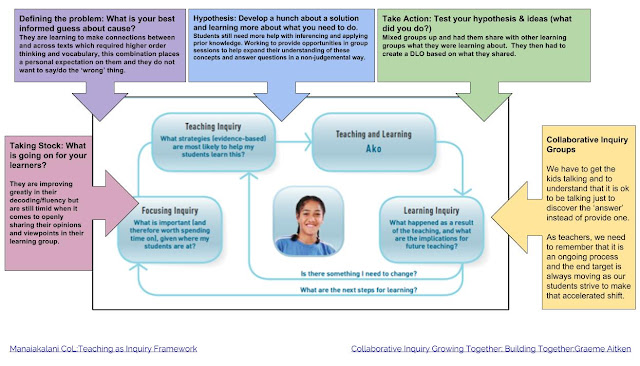
We have now reached the halfway mark of the school year, and as part of our first CoL meeting of Term 3 we were asked to spend some time reflecting on where we are with our on Teaching as Inquiry Framework.  The graphic below was provided for us to fill out as we collected our thoughts before meeting with our CoL Achievement Challenge groups.  
https://docs.google.com/drawings/d/1nLH5GX0NwEaRcQr0BVvM0cC6_g-pEb4k5TPEZhLzNjo/edit?usp=sharing

By sharing our hunches, successes and failures with our colleagues from across the CoL we are given an unique opportunity to learn from and be encouraged by others who are striving to achieve a common goal within their own classrooms. 

Thursday, 27 July 2017

Learning from Previous Spark MIT Inquiries

As part of our Term 2 Spark MIT Inquiry, we were tasked with spending some time reviewing and making connections to the Inquiries of previous Spark MIT Teacher Inquiries.

After reviewing the Spark-MIT website and looking at various participant's focus questions, I spent some time watching the final presentations of a few prior participants.  It is so interesting to look back at these presentations and see how teaching has changed (and student achievement has increased) across Manaiakalani over the years, sometimes as a result of the findings of these inquiries.

One Inquiry in particular had me directly thinking of my personal inquiry and the things I have implemented in my classroom this year.  I spent some time looking into this inquiry when I was formulating my own plan of attack for working with the Year 4 students this year.  It has been so beneficial to look back once again and reflect on some aspects of Kent's inquiry and how I have been able to implement some of those same ideas with a much younger cohort of students.

Kent Somerville: How do you hook and cognitively engage students to read a range of texts?


  • Increasing student mileage: using daily silent reading to hook students into reading books they have selected.  This is student driven and students are provided with a time to talk to their friends about key elements of the story to "sell" the book to their friends.  Interesting to find that most kids shared what books they did not like and clearly explain why using passionate language. I have been trying to do this with my class, but we are often working against the clock with our literacy time frame.  Unfortunately, I tried implementing it as a whole space activity earlier this year, but it was not something that was easily implemented on a daily basis across the space. 
  • School was missing book sets that were targeting to the group of kids he was working with.  This is definitely that I have noticed this year as well while trying to find new and fun ways to engage the group of students that I have been working with.  I have been building up my own collection of books to use as a self-selected text library, but I would love to have a larger variety of longer texts (chapter books) to use with students reading at this level.  The most important aspect here is to find texts that they can relate to or find interesting to read. 
  • Students were motivated to write to their blog readers about the "special" books they have read My students have really enjoyed doing this throughout the year as well.  They are very excited to blog something that is not directly related to a scaffolded assignment.  This has allowed some of the students to realise that their blog belongs to them and many have begun blogging outside of the classroom about other things happening in their lives.
  • Kent also began using Extended Texts with his students to build upon the knowledge they had on a topic, which allowed them to dive deeper into a topic.  This allowed for higher levels of comprehension, and understanding of a topic. Definitely something that we have moved to as a Cluster based on the WF Research gathered over the years.  I am so excited to see the development of the database and how effectively it will be able to help provide support for teachers in years to come.
  • Used their blogs to share animations and movies based on the content they were learning about in class, but it was realised they weren't sharing the richer portions of their learning.  In an effort to fix this, students began to store their knowledge by writing full paragraphs about their understanding of a topic.  This allowed them to go back and reread, which provided rewindable learning for the students, and extended voice as the blog author for their readers to gain a deeper understanding.  Definitely a barrier to crack with Year 4 students who are not used to having the freedom to type directly onto their blogs and add their own summary of their learning using their student voice.