Monday, 19 February 2018

DMIC: Session 2 with Bobby Hunter


DMIC-Session 2

Bobby began our session together by asking our staff to discuss the following questions:


  • What are we doing so far that is good? 

  • What are we doing that is puzzling/problematic

After providing us with some time to talk in a small group, we shared with the staff our answers. The following is a rundown of her responses to our discussion.

In general guided lessons, who is doing the teaching? Who is doing the talking? THE TEACHER...we need to work towards the students taking control of the learning and the teacher facilitating THEIR discussion.

Begin by using problems that are not at grade level in order to get the kids used to talking. Once you start to see wins in your routines, and talking groups...then move things along.

Everyone in the group needs to be working in a way that allows for them each to be critiqued. Everyone needs to be struggling in their effort to learn something new.

We do less but students are learning at a deeper level with multiple levels of understanding.

We, as teachers, need to be working on the possibilities of what they should know instead of focusing on what they don’t know (and filling gaps).

When kids argue...Talk about how you are not disagreeing with a person but you are disagreeing with an IDEA. Also, make sure that the students understand that it is ok to have a disagreement if you are able to express why you disagree.

Setting Up Your Class for Group Work 

Social and Strengths groups...these are not friend-based groups. They are groups of students that you know will work well together.

Class is split into halves-each half seen on alternative days. However, always have one group of 4 that you could see 2 days in a row to give them an opportunity to grow or teach others their different thinking.

Groups of 4 (2 for younger children)

One challenging task. If any student can solve it on their own it is not challenging enough)

Encourage recording and multiple representations

One Lesson

10 minutes Warm Up
5-10 minutes Launch/group norms..need to discuss everyday (values/beliefs...keep it family orientated)
15 minutes Small Group Activity
15 minutes Large Group Discussion
10 minutes Making connections to the big idea* (this is where the teacher explicitly teaches and connects to the big idea*)

Teacher Role: anticipate, monitor, select, sequence, connect

Remember to focus that we work together as a collective (a family). No one owns that end product...it belongs to the group/village.

*The Big Idea: this is something that encompasses the higher mathematical teaching...for example commutative property (a+b=b+a)

Quick Image problems: are ok to use instead of word problems as their task

Independent Work

Make it purposeful

Include elements of choice

Make the practice related to previous maths focus (problems from previous days, refer to previous problems)

All students should use this time to cement previous learning.

Focus Group: Gathering Evidence

At this point in the school year, I have been focusing on getting to know my students, and setting up classroom routines and expectations. However, I have also been working to develop my CoL focus group and learn more about these students in particular. 


Tuesday, 13 February 2018

Hunches: What do I see?


-Oral reading of novel at/above grade level everyday (straight forward reading...with quick pull apart after)
-Implementing talk moves strategies in Literacy while promoting discussions in pairs, small group and whole class

-Begin by reading Jannie’s book (see Russell) for possible ideas to implement

- Integration with Writing???

Problem Defined:
How can we use dialogic discussions to expand vocabulary usage while strengthening reading comprehension?

Possible Hypotheses:

Students need to develop confidence applying prior knowledge and vocabulary to new situations and experiences and understand that learning from one year (or one term) to another builds upon the previous. In order to provide opportunities for this to happen:
  • Students need to be exposed to higher level vocabulary in a variety of ways
  • Students need to be exposed to words in a variety of settings linking them together
  • Students need to develop the confidence to talk in a large group setting in order to hold a beneficial dialogic discussion linking vocabulary, prior knowledge and information from a text
  • Students need to understand the elements of a beneficial dialogic discussion, using Talk Moves

Evidence of Need:
According to the Wolf Fisher Research Centre, our students learn by talking about what they are learning (dialogic conversations).  However, over time students often fail to use effective vocabulary to explain their thinking and link their learning from one year to another. 

Data Gathered:
  • Student PAT and STAR results-Nov 2017 
  • Student PAT and STAR results-Feb 2018
  • Running Records-Nov 2016 
  • 2017 Teacher OTJ-Reading
  • Reading previous student Blog posts 
  • In class micro group discussions

Next Steps:
  • Read Dr Jannie van Hees' book and decide how/what to apply to my classroom setting
  • Explore ways to incorporate the use of Talk Moves into daily discussions
    • Directly Model/Teach how to use each Talk Move
  • Scan the class with a Google Form survey to formulate genre/topic interests 

Thursday, 8 February 2018

Language in Abundance

During our first Manaiakalani CoL meeting, we had the privilege to hear from Dr. Jannie van Hees about Language in Abundance. She spent some time giving us a quick overview about what that means for us as educators. I am excited to once again be focusing on optimising the learning conditions of my classroom so that my students are able to flourish in their understanding and usage of vocabulary across the curriculum.

What LANGUAGE offers a person’s LEARNING?
How LANGUAGE offers LANGUAGE CAPABILITY?
Dr. Jannie van Hees


Language in Abundance is NOT a program.  It is simply what it is...when children are
provided language in abundance they will thrive in all areas.


Learning conditions make a difference.
-Learning about ‘something’ with MORE or LESS spoken or written
language available.
-Knowledge DOES make a difference and it is available to us
through language.  Words matter hugely!
                           
Language in Abundance: What does it mean for us?
-providing opportunities to talk
-accepting what is said and adding on in order to gift further understanding
-complete culture where everything is accepted and freedom to be shared
-High expectations
-Being allowed to be aloud.
-Make it normal for students (at any age) to explain in any context
-Being able to explain a word


Always be thinking of the language involved and how you are going to get the children to
access it.


What can we do?
What can you do?
What can learners do?
What can families do?

Language in abundance will not simple provide uptake...it also involves optimising
learning conditions in order to flourish learning.

Rebecca Jesson: Meta Analysis of Inquiries

During our first Manaiakalani CoL meeting of the year we were blessed to hear from Dr. Rebecca Jesson once again from the Woolf Fisher Research Centre at Auckland University. This year, the research team is going to spend some time looking more closely at our Inquiries into our Teaching Practise as the year progresses and I am so excited to see what we are able to learn from each other in a combined effort to ensure accelerated progress for our students.

Meta Analysis of Inquiries

Rebecca Jesson
Woolf Fisher


“WFRC will analyse data and evidence from teachers’ inquiries to identified Learn Create Share practices likely to
contribute to accelerated progress for students.”


How can the power of inquiry be used to feed into the research of Woolf Fisher?  Meta Analysis will enable WF to
indicate elements of ‘what works.”


Knowledge building is part of our Inquiry process.


Meta Analysis is intended to:
  1. Address persistent learning challenges at scale
  2. Develop teacher knowledge based on teacher inquiry
  3. Transfer researched approaches into practice at scale


What is a Meta Analysis?
  1. Combined estimate of the effects of a particular approach (treatment)
  2. Assessment of whether the effects are statistically significant (likely to be more than no effect 95% of the time)
  3. Assessment of whether the effects are stable (does it vary a lot?)


What does this mean for us?

  1. Address learning challenge
  2. Building personal knowledge
  3. Identify clear research informed changes to practice likely to address the challenge
  4. Collect detailed evidence about changes to the teaching
  5. Collect detailed evidence about how students engaged with the changed teaching
  6. Gather data about effects on student learning

Friday, 26 January 2018

DMIC: Our Initial Discussion With Bobby Hunter

Developing Mathematical Inquiry in a Learning Community
Bobbie Hunter

The staff at Pt. England has begun having PD with Dr. Bobbie Hunter, Massey University.  We are looking into creating a learning community for our children that involves teaching using a mathematical inquiry model.  Here are my notes/thoughts from our first session as a staff. 


What DOES work for diverse children will also work for ALL children. We need to be developing children who are doing the thinking...not just listening.

There is a misconception among many NZ primary teachers that Pasifika children come to school ‘not knowing anything’ when it comes to maths. However, the truth is that they know a lot of applied maths (setting the tables, laying out the mats, cutting sandwiches into fractions, etc).

It is important to provide current cultural context for our students. They may be Samoan but they are living here! What are the things they experience on a daily basis in their immediate environment.

NZ has the widest disparities between the cans and the cannots when it comes to kids and maths.

It is important to remember that Culture and Mathematics are Intertwined

Every culture uses maths in context to items that are specific to them. Students need to be encouraged to share intellectual problems that relate to them. When writing problems always ask, “Will my students be able to relate to this question?”

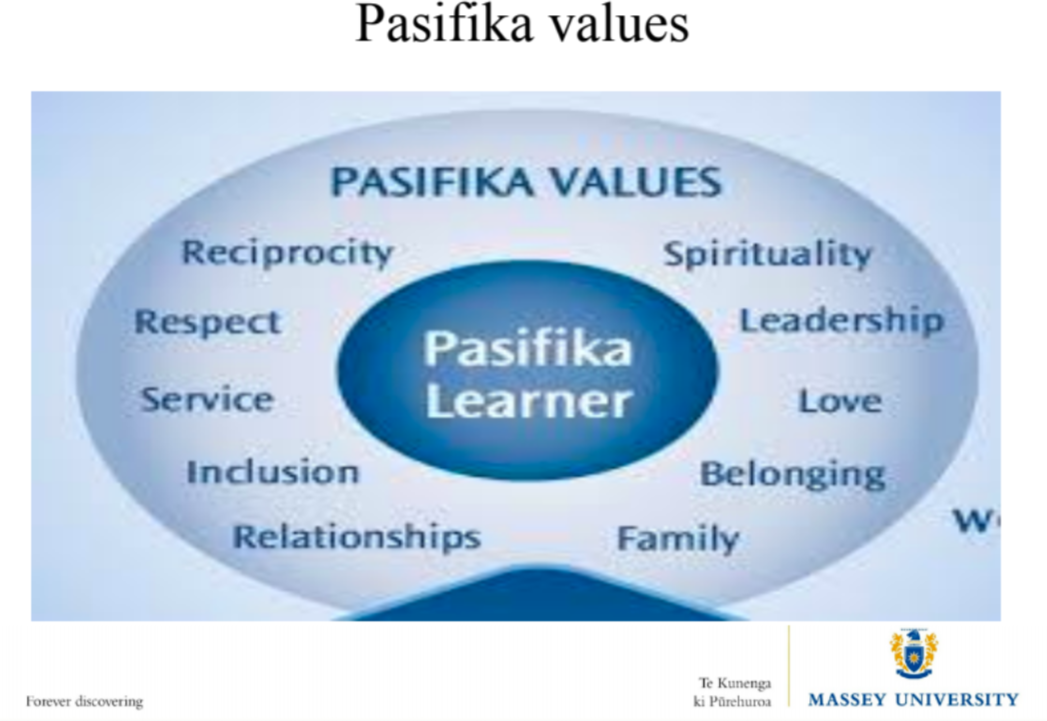
In order to bring the cultural aspect into a classroom you MUST look at their values.


Instead of saying “work as a team” rephrase to “work as a family”
Service concept - idea of individually helping others before helping yourself


DMIC-Developing Mathematical Inquiry Communities
  • Connected, rich mathematical thinking and reasoning
  • Proficient use of mathematical practices
  • Inquiry learning within mathematics
  • Social grouping and group worthy problematic activity
  • High expectations and inclusion
  • Culturally responsive teaching and learning
  • Co-constructing teaching and learning

Talk Moves are important for promoting student interactions when discussing student explanations. (eg. why? how?)

If every teacher made their math problems a level or two high than where the students are achieving, our maths scores will increase dramatically.

-It is important to let the kids know that the problem is hard...it is ok to struggle and work on it over a few days.
Mathematical Practices


As a teacher, it is important to add on the “because” when reacting to student involvement (eg. “That was a really good question/explanation because…”)


  • Making a claim/conjecture 
  • Taking time to hear and acknowledge the conjecture (jot it down) and come back to it at the important time
  • Developing a mathematical explanation
  • Justifying thinking
  • Constructing arguments
  • Generalising a mathematical idea
  • Representing mathematical thinking using pictures, material, and numbers
  • Using mathematical language


Launch (can take ½ a lesson on day one but will decrease the following days)
  1. Put the problem in front of the children...keep it in context, available and have the students read it.
  2. What is happening in the story? What is going on? (add-on, repeat, teacher revoice) Until the ALL understand the story.
  3. What is it asking us to do? DO NOT focus on operations. Focus on concepts, not how to solve it.


5 Minutes to work on the problem alone (if students seem to want the time). Then, move to working in a group to find a collective way to solve and explain their process on a large sheet of paper.


We are NOT thinking number knowledge and strategy we are focusing on the BIG idea.  We use number knowledge in order to work within a strand, which should be our focus.


Teachers need to always use the problem context to make the explanation experientially real.


Groups should only have one piece of paper and one writing tool.  They should be in groups of 4.


When students are given multiple opportunities to discuss, inquire, mathematically argue and sense make as they engage in mathematics.


Active listening and questioning for sentence making
  • Discuss and role-play active listening
  • Use inclusive language “show us’, “we want to know”, “tell us”
  • Structure the students explaining and sense making section by section
  • Emphasise need for individual responsibility for each other.
Encourage students to listen to (and look at) the student who is presenting.


Only work with about 12-16 students (in groups of 4) at a time and then rotate.  This will allow for students who don’t quite get it to join in with the other group the next day.


Thursday, 25 January 2018

2018 Manaiakalani Teaching As Inquiry Framework

My 2018 CoL Inquiry Focus:
“Using dialogic discussions to expand vocabulary usage while strengthening reading comprehension.”

The Manaiakalani Community of Learning is working together on this task using the expertise existing in of our community of learning.

In 2018 for my inquiry I have selected the following CoL achievement challenge: 
3. Lift the achievement in reading for all students, with a particular focus on boys and Māori students (both genders), years 1-13

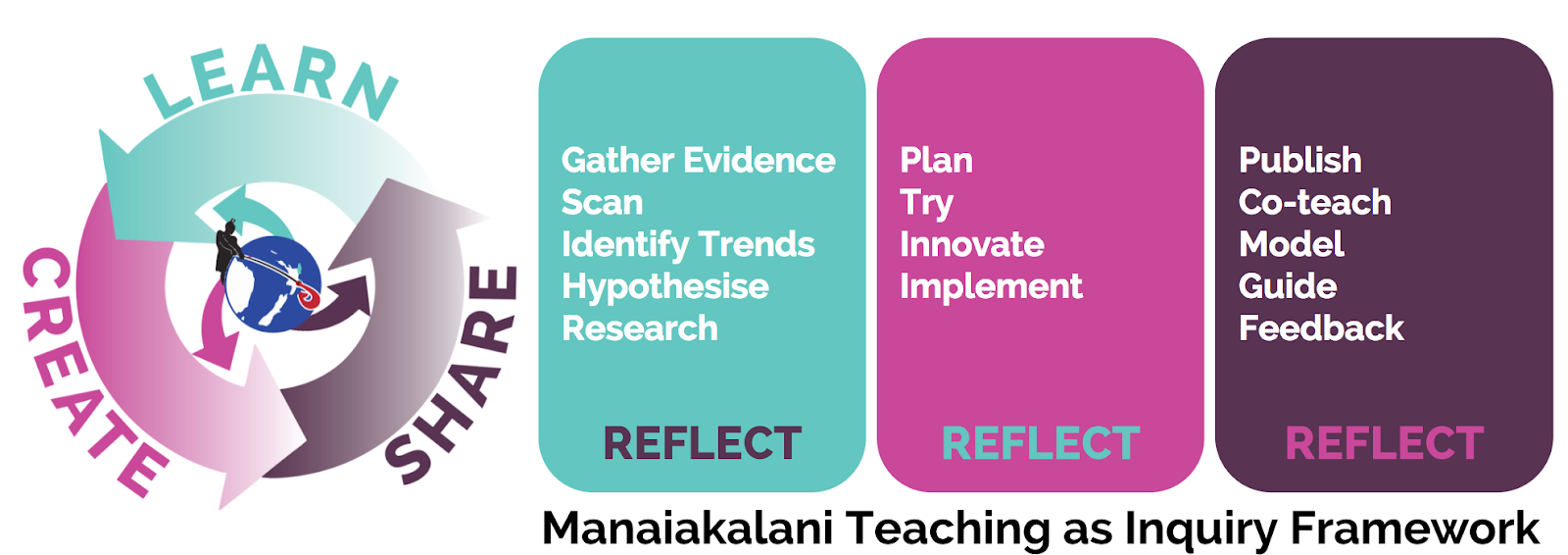
The teaching as inquiry framework I will continue to use in 2018 has been specifically co-constructed for Manaiakalani schools using our familiar Learn Create Share structure.

The elements in this framework share close similarities with other models New Zealand teachers use.


Throughout the year, I will be labelling my blog posts to reflect our Learn, Create, Share structure.


LEvidence
Learn - Gather Evidence
CPlan
Create - Make a plan
SPublish
Share - Publish
LScan
Learn - Scan
CTry
Create - Try new things
SCoteach
Share - Co-teach
LTrend
Learn - Identify Trends
CInnovate
Create - Innovate
SModel
Share - Model
LHypothesise
Learn - Hypothesise
CImplement
Create - Implement
SGuide
Share - Guide
LResearch
Learn - Research
CReflect
Create - Reflect
SFback
Share - Feedback
LReflect
Learn - Reflect


SReflect
Share - Reflect