Friday, 24 February 2017

2017 PES Maths Inquiry

This year, the teachers at Pt. England will be receiving Maths focused Professional Development.  In addition to this PD, we will be conducting our own personal inquires into our own teaching practice of maths.

My 30 (Year 4) Maths students range in ability from NZ Curriculum Stages 1-early 5.  The majority of my students are working below or well below grade level expectation.  

I have decided to focus my inquiry on investigating which method(s) of rewindable learning will be most beneficial to achieving accelerated learning with my below and well-below students.  I will also be inquiring into the best ways to build student confidence and understanding of basic maths knowledge in an effort to have accelerated learning take place by the end the school year.  


clipart prof de maths

Monday, 20 February 2017

Spark Manaiakalani Innovative Teacher

Today was our first day meeting as the Spark Manaiakalani Innovative Teacher (MIT) cohort.  We had a wonderful day meeting together at the Spark building in Auckland, NZ sharing what we have defined as a problem that we are going to inquire into.  We also spent some time identifying possible hypotheses as to why this is a problem area for our students.

Problem Defined:
How can we extend prior knowledge and critical thinking in an effort to promote dialogic conversations in year 4 students who are reading at/above grade level?

Possible Hypotheses:
Students have not been given the freedom (in earlier years) to explore further on their own into aspects of their text/topic that spark interest.
  • Students are not equipped with how to further explore a topic of interest from their text.
  • Students need to be taught how to manage their time appropriately in order to complete learning tasks.
  • Teachers are not definite on when to shift the focus of learning from decoding to reading for content and formulating deeper understanding from exposure to multimodal texts.
  • Teachers are afraid of the time commitment needed in order the plan for extended reading lessons that go deeper for understanding.  
  • Teachers are unsure where to look for age appropriate reading material.

Planned Innovation:
What would be the best way to compile a cross-cluster database to house texts linked by topic according the reading level?

Evidence of Need:
According to the Wolf Fisher Research Centre, our students learn by talking about what they are learning (dialogic conversations).  These conversations are mostly effective when students have a deeper understanding of a topic from being exposed to multimodal texts.  

Data Gathered:
  • Student PAT and STAR results-Nov 2016 
  • Student PAT and STAR results-Feb 2017
  • Running Records-Nov 2016 
  • 2016 Teacher OTJ-Reading
  • Reading previous student Blog posts 
  • In class micro group discussions

Tuesday, 7 February 2017

Manaiakalani Teaching as Inquiry Framework

My 2017 CoL Inquiry Focus:
“Extending prior knowledge and critical thinking, while promoting dialogic conversations with students who are reading at/above grade level.”

The Manaiakalani Community of Learning is working together on this task using the expertise existing in of our community of learning.

In 2017 for my inquiry I have selected the following CoL achievement challenge: 
3. Lift the achievement in reading for all students, with a particular focus on boys and Māori students (both genders), years 1-13

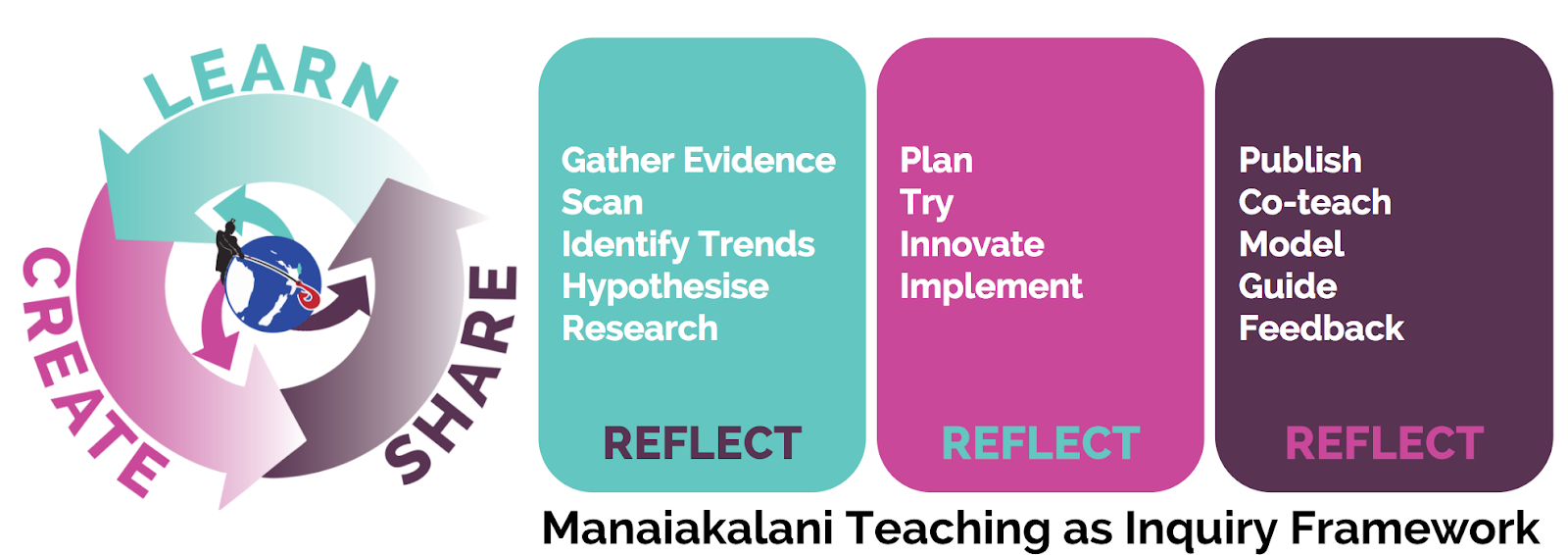
The teaching as inquiry framework I will be using in 2017 has been specifically co-constructed for Manaiakalani schools using our familiar Learn Create Share structure.

The elements in this framework share close similarities with other models New Zealand teachers use.


Throughout the year, I will be labelling my blog posts to reflect our Learn, Create, Share structure.


LEvidence
Learn - Gather Evidence
CPlan
Create - Make a plan
SPublish
Share - Publish
LScan
Learn - Scan
CTry
Create - Try new things
SCoteach
Share - Co-teach
LTrend
Learn - Identify Trends
CInnovate
Create - Innovate
SModel
Share - Model
LHypothesise
Learn - Hypothesise
CImplement
Create - Implement
SGuide
Share - Guide
LResearch
Learn - Research
CReflect
Create - Reflect
SFback
Share - Feedback
LReflect
Learn - Reflect


SReflect
Share - Reflect

Wednesday, 25 January 2017

2017 PD: Connecting With Manaiakalani

This year I will be working as a CoL Teacher within my school, and as a part of this role I spent today at Day 1 of the Manaiakalani Cluster Orientation.  It was a great day collaborating with staff from across the cluster, including those who are knew to our cluster this year.  We spent the day hearing from Dorothy Burt about Who, What, How, and Where of Manaiakalani.


It was so amazing to be reminded about the backbone of what drives Manaiakalani to do the amazing things we are blessed to do to serve our community and the learners within it.  My favourite part of the day was the simple reminder that Manaiakalani is about the people...not the computers.  It is about making a difference in the lives of our students and their whanau by enabling them to become 'confident, connected, life-long learners'.


Tuesday, 24 January 2017

Things That Work-PD w/ R. Jesson

Today, as part of our back to school PD, our staff met with Dr. Rebecca Jesson from the Woolf Fisher Research Centre to discuss "Things that Work" according to our cluster and school wide data.

High Ticket Items for High Progress Teachers
  1. Critical Thinking
  2. Extending Reading/Writing (Mileage)
  3. Extended Discussion


How can we continue to raise the ceiling for our fluent students and still provide advanced learning for our kids who are struggling?


We Need to Continue:
  1. Focused reading instruction/guided reading
  2. Extra mileage from reading literature and reading to inquire (wide)
  3. Extra thinking through discussion about illustrations/inferences/perspectives/author’s craft (deep)
  4. Scaffolding for independence in reading


Risks of Scaffolding:
  1. Dependence:
    1. Teacher attention (noticing)
    2. Teacher correction (fixing)
  2. Narrowed opportunities for Learning
    1. Read aloud (so read less)
    2. Receive more item knowledge instruction (read for meaning less)
    3. Engage in tasks with less ‘holding power’ (read less) and off task more
    4. Given less to read (read less)
    5. Get interrupted more often, by more people, more quickly (read less)


Scaffolding both Wide and Deep:
  1. Choosing content for thinking
  2. Choosing texts for thinking
  3. Ensuring balanced diet of texts to build thinking over time
  4. Generating discussion for thinking


Critical Decision #1
Content choice-important, contestable, relevant
    1. Reading and writing about something
    2. Reading and writing to access the curriculum at level
Critical Decision #2
Text Choices
Critical Decision #3
Textual Diet:
Narrative dominates:
  • Controlled Vocabulary
  • Controlled Challenge
  • Tight Learning Focus
Critical Decision #4
How to generate student discussion:
  • We know children tend to guess what’s in your head
  • Often say as little as possible to let you know they know what’s in your head
  • Find ways to communicate that the purpose is to build on one another’s thinking

Thursday, 15 December 2016

Visible Learning in a Year 5/6 Classroom

Teaching in a Manaiakalani classroom means that my students have their learning visible online (via Google Sites). This means that a visible learning process leads to my students sharing their evidence of learning on their student blogs. Below is a screencast demonstrating a visible learning pathway for my student's this year.  


Monday, 5 December 2016

Accelerated Learning From Reading Wider and Deeper

As a result of our PD from Dr. Rebecca Jesson and the Wolfe Fisher Research Centre, the Team 4 teachers (of year 5/6 students) decided early on this year to refocus the way we approached our Reading Assignments. Students were given a 2-3 week mini-topics that supported our term long school topic focus. During those mini-topic inquiries, students explored an underlying topic in more depth through the use of multi-modal texts consisting of School Journal Articles, Online Articles, In Class Demonstrations and Online Videos. As a result of our strategic wider and deeper reading, our students have been able to confidently engage in dialogic conversations during their micro-teaching groups and with their peers across our ILE.

Originally, we decided to focus our wider/deeper reading to our students who were reading at age 9 and above. Due to the make up of my literacy class, this meant that I would be going wider/deeper with 10 of my students (rougly 1/3). However, as the term progressed, I started to use similar lessons, with many of the same reading assignments, with my students reading anywhere above age 7. It is important to note that the way my students were expected to read the texts varied based on their learning group and reading age. Generally my students reading above age 9 were expected to read the text silently to themselves during their micro-group lesson prior to opening the floor for a dialogic conversation to take place. When looking at my students reading from age 7 to 9, we would often take turns reading the text aloud in our micro-group. Other times, I would point students to one specific paragraph or section of the text that I thought was most important for us to spend some time looking at.

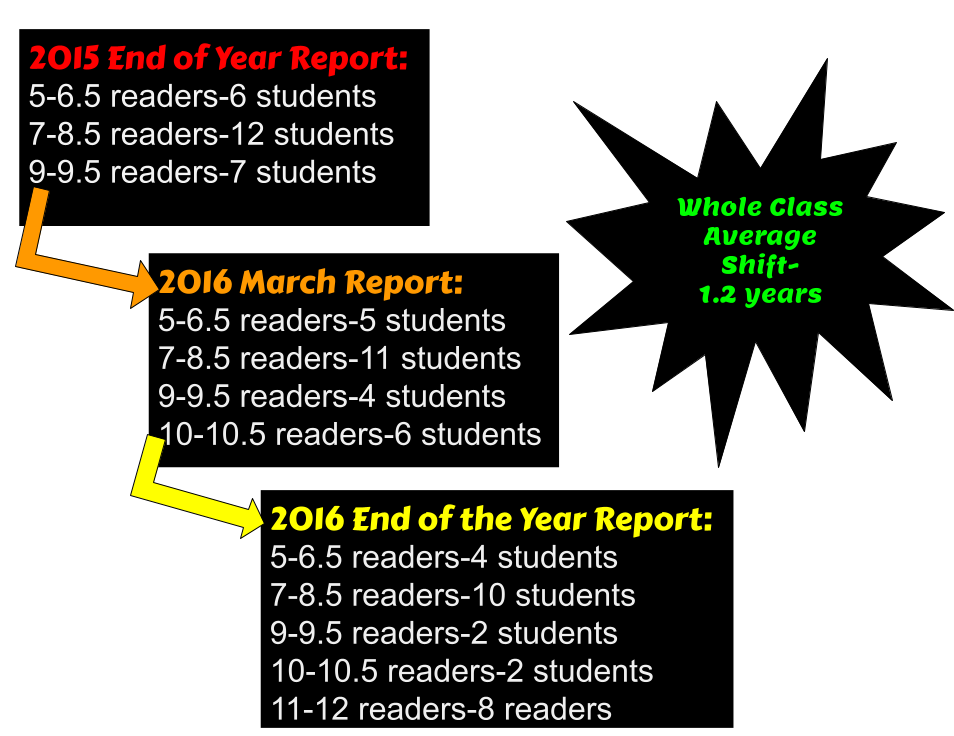
Students were more engaged, and conversations in my classroom increased greatly. Students were also more focused when working on their follow up and create tasks. That's great and all, but what does my data show?

My data for the end of the year is amazing! I am so proud of the achievement that my students have made, and I look forward to working to see how to make this work again next year.  I only had three students who did not increase their reading age this year. All of those students have been receiving services outside of the classroom and have made their own personal achievements to their learning during the school year not measured on a Running Record.